05 Dundas Street
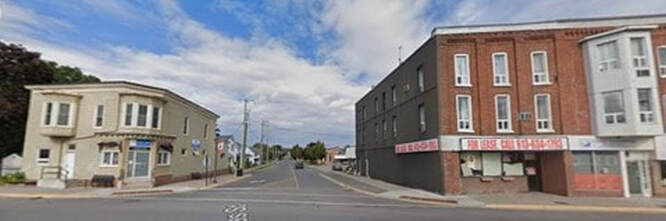
The south side of Dundas Street contains odd-numbered addresses and begins with No. 5. The corner of Dundas and Prince Edward Street is occupied by the old Proctor Block buildings. The north wall of these buildings is at the sidewalk of Dundas Street with no addresses from the corner to No. 5.
Today, No. 5 Dundas Street is a small one-story structure built on the east side of the Proctor Block building. It extends south in a second small structure that is also one storey.
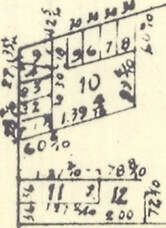
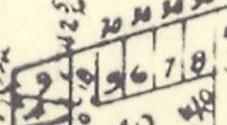
This segment of the Brighton Plan 1866 shows the village lots that were located on the south side of Dundas Street near Prince Edward Street. The lots at the corner were associated with Prince Edward Street, so the first Dundas Street lot was actually an extension of lot 10 onto Dundas Street.
The history of this property begins with the Patent from the Crown to Ann Marsh for all 200 acres of lot 35, concession A, Murray Township in 1825. Brighton Village was created in 1831, which led to the creation of village lots.
Today, No. 5 Dundas Street is a small one-story structure built on the east side of the Proctor Block building. It extends south in a second small structure that is also one storey.
This segment of the Brighton Plan 1866 shows the village lots that were located on the south side of Dundas Street near Prince Edward Street. The lots at the corner were associated with Prince Edward Street, so the first Dundas Street lot was actually an extension of lot 10 onto Dundas Street.
The history of this property begins with the Patent from the Crown to Ann Marsh for all 200 acres of lot 35, concession A, Murray Township in 1825. Brighton Village was created in 1831, which led to the creation of village lots.
In 1834, Ann Marsh and son Archibald Chisholm sold the west half of the west half of lot 35 to her son John Singleton and he sold in the next year to William Robertson (1800-1861), a prosperous Scot who lived in Belleville and invested in real estate in Brighton during the 1830s and 1840s. He was involved in numerous properties on the east side of Prince Edward Street as well as on Dundas Street. A decade later, in 1845, William Robertson sold lot 10 to Adam Henry Meyers (1763-1832), a merchant at Trent Port who was very active in real estate speculation in the wider area. He bought and sold a seemingly endless list of properties over several decades.
Mr. Meyers sold the same land in 1847 to John Spence who sold it in 1853 to Smith Whittier and Henry Squier who were merchants working in partnership operating stores in Brighton. Smith Whittier (1828-1896) was from Consecon and became involved in several businesses in Brighton as well as partnerships in mills and real estate projects. Henry Squier (1815-1871) was very active in business at this time, although his brother, Abijah Squier (1817-1855) was better known with his enterprises, being in partnership with John Edward Proctor for a store on Young Street.
A decade later, in 1863, there was a sheriff’s sale to Edward McKay who sold lot 10 to Mathew Ferris (1832-1893). This fellow owned the properties on the east side of Prince Edward Street as well as the north-east corner of Dundas and Young Street. He operated a dry goods store at the corner of Dundas and Prince Edward Street and appears to have acquired land east of there, behind his buildings, including parts of lot 10.
Mr. Meyers sold the same land in 1847 to John Spence who sold it in 1853 to Smith Whittier and Henry Squier who were merchants working in partnership operating stores in Brighton. Smith Whittier (1828-1896) was from Consecon and became involved in several businesses in Brighton as well as partnerships in mills and real estate projects. Henry Squier (1815-1871) was very active in business at this time, although his brother, Abijah Squier (1817-1855) was better known with his enterprises, being in partnership with John Edward Proctor for a store on Young Street.
A decade later, in 1863, there was a sheriff’s sale to Edward McKay who sold lot 10 to Mathew Ferris (1832-1893). This fellow owned the properties on the east side of Prince Edward Street as well as the north-east corner of Dundas and Young Street. He operated a dry goods store at the corner of Dundas and Prince Edward Street and appears to have acquired land east of there, behind his buildings, including parts of lot 10.
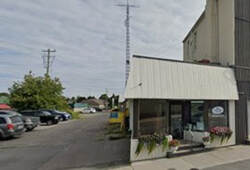
Mathew Ferris had married Sarah Elizabeth Proctor (1839-1882) in 1860, the daughter of Isaac Chamberlain Proctor and therefore a sister of John Edward Proctor and Isaac Oscar Proctor. In 1876, Mathew Ferris sold this property to Isaac O. Proctor who sold on the same day to Elizabeth Ferris. Elizabeth (Proctor) Ferris died in 1882, so the property reverted to her husband, Mathew Ferris. Then, in 1889, Mathew Ferris sold his property at the corner of Dundas and Prince Edward Street to Isaac O. Proctor, including parts to the east in lot 10.
In January of 1891 there was a destructive fire in the Ferris dry goods store and Mr. Ferris decided not to rebuild. By that time, the Proctors owned the property from the corner of Dundas and Prince Edward Streets to the south for several lots and that is where they built the Proctor Block which contained the Proctor Hotel. Over the next few decades, the space behind the hotel, in lot 10, was utilized for stables and livery services, as well as various businesses that changed a lot over time.
In 1901, Clarence Donaghy had a grain chopping business here. Two years later, George M. Herrington was a machinery agent. From 1904 to 1907, W. T. Fitzgerald had a carriage and paint shop here. From 1949 to 1954, Hughes Electric was the tenant. In 1965, there was a tailor ship for “Ladies and Gents”.
Charles Proctor, son of John E. Proctor, was manager of the Standard Bank in Brighton and had inherited much of his father’s land. He had moved to Calgary but still owned lot 10 and other properties in Brighton. Finally, much of the property was sold to Cy Boyce in 1967. Arthur Cyril Boyce (1916-1976) came to Brighton in the early 1960s and had a TV and radio shop in part of the Proctor Block for several years. His estate sold this part of lot 10 in 1976 to John Schneider, a very active businessman and speculator in the area. While Schneider owned the space, Re-Max had an office here, then Harvey Lock & Key Service, then Mike’s Books & Video.
In 1987, John Schneider sold this property to Sarbans Roda, Manjit Singh Sehdev & Man Mohan Singh Sia and the next year passed it to a numbered company. During this period the tenants here were Brighton Curiosity Shop, Gooney’s Books & Videos. In 1998 there was an ownership change and after that the tenants were Brighton Bay Antiques, Corner Station, Creative Hair Design and, up to 2026, the Odd Jobs Couple.
In January of 1891 there was a destructive fire in the Ferris dry goods store and Mr. Ferris decided not to rebuild. By that time, the Proctors owned the property from the corner of Dundas and Prince Edward Streets to the south for several lots and that is where they built the Proctor Block which contained the Proctor Hotel. Over the next few decades, the space behind the hotel, in lot 10, was utilized for stables and livery services, as well as various businesses that changed a lot over time.
In 1901, Clarence Donaghy had a grain chopping business here. Two years later, George M. Herrington was a machinery agent. From 1904 to 1907, W. T. Fitzgerald had a carriage and paint shop here. From 1949 to 1954, Hughes Electric was the tenant. In 1965, there was a tailor ship for “Ladies and Gents”.
Charles Proctor, son of John E. Proctor, was manager of the Standard Bank in Brighton and had inherited much of his father’s land. He had moved to Calgary but still owned lot 10 and other properties in Brighton. Finally, much of the property was sold to Cy Boyce in 1967. Arthur Cyril Boyce (1916-1976) came to Brighton in the early 1960s and had a TV and radio shop in part of the Proctor Block for several years. His estate sold this part of lot 10 in 1976 to John Schneider, a very active businessman and speculator in the area. While Schneider owned the space, Re-Max had an office here, then Harvey Lock & Key Service, then Mike’s Books & Video.
In 1987, John Schneider sold this property to Sarbans Roda, Manjit Singh Sehdev & Man Mohan Singh Sia and the next year passed it to a numbered company. During this period the tenants here were Brighton Curiosity Shop, Gooney’s Books & Videos. In 1998 there was an ownership change and after that the tenants were Brighton Bay Antiques, Corner Station, Creative Hair Design and, up to 2026, the Odd Jobs Couple.
7 Dundas Street
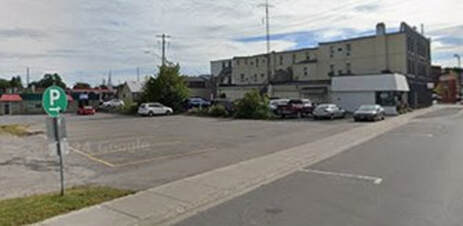
Today, when we look east from 5 Dundas Street, all we see is parking lot, right up to Alice Street. However, there were buildings between #5 and Alice Street until that area was developed around the new municipal office in the 1980s.
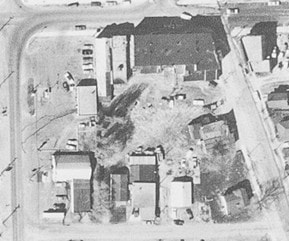
A useful reference in this regard is the aerial photograph of this area taken in the 1960s which shows the buildings in the block of Prince Edward, Elizabeth, Alice and Dundas Streets. The Proctor Block buildings on Prince Edward Street are very obvious and we can see the small attached structure to the east side which is 5 Dundas Street.
Looking east from there, we can see some driveway and parking space, but then there is are two structures very close together. This was 7 Dundas Street. While it many not be very clear, there are two separate buildings right beside each with smaller additions on the side.
A useful reference in this regard is the aerial photograph of this area taken in the 1960s which shows the buildings in the block of Prince Edward, Elizabeth, Alice and Dundas Streets. The Proctor Block buildings on Prince Edward Street are very obvious and we can see the small attached structure to the east side which is 5 Dundas Street.
Looking east from there, we can see some driveway and parking space, but then there is are two structures very close together. This was 7 Dundas Street. While it many not be very clear, there are two separate buildings right beside each with smaller additions on the side.
|
|
The history of this area is difficult to explain because there are four village lots involved, lots 5, 6, 7 and 8. Also, businesses spread out into lot 10, which adds another layer of complexity in finding land records. In fact, it is not so difficult to find the records, but determining which records apply to which person or business is a challenge.
Focussing first on Village Lot 6, we can see that the same history applies that we saw for 5 Dundas Street, until the 1850s when the partnership of Whittier and Squier sold the property to John Adams, who sold to Elmire Precur, who sold to Isaac B. Demille. Isaac Brock Demille (1834-1921) was from Northport in Prince Edward County and came to Brighton in the 1860s. He married Elizabeth Ann Wellington (1849-1897), a daughter of Isaac Maitland Wellington and Ann Wright. Isaac Demille operated a busy hardware store on Main Street where Lola’s Café is today and was very active in real estate in Brighton and Presqu’ile Point.
In 1883, Demille sold lot 6 to James Nesbitt and three years later he sold it to Mathew Ferris. It went to Isaac O. Proctor in 1889 along with the other land at the corner. After the fire in 1891 and the building of the Proctor Block, this area was part of the stables and livery service for the hotel. Lot 6 followed the same path as the extension of lot 10, and may have been split between 5 and 7 Dundas properties at times.
Focussing first on Village Lot 6, we can see that the same history applies that we saw for 5 Dundas Street, until the 1850s when the partnership of Whittier and Squier sold the property to John Adams, who sold to Elmire Precur, who sold to Isaac B. Demille. Isaac Brock Demille (1834-1921) was from Northport in Prince Edward County and came to Brighton in the 1860s. He married Elizabeth Ann Wellington (1849-1897), a daughter of Isaac Maitland Wellington and Ann Wright. Isaac Demille operated a busy hardware store on Main Street where Lola’s Café is today and was very active in real estate in Brighton and Presqu’ile Point.
In 1883, Demille sold lot 6 to James Nesbitt and three years later he sold it to Mathew Ferris. It went to Isaac O. Proctor in 1889 along with the other land at the corner. After the fire in 1891 and the building of the Proctor Block, this area was part of the stables and livery service for the hotel. Lot 6 followed the same path as the extension of lot 10, and may have been split between 5 and 7 Dundas properties at times.
If we then look at Village lot 7, we see the same path with the exception that Whittier and Squier sold to Charles S. Becker, who sold to Robert J. Morrow and then to Mathew Ferris, to continue the same path as lot 6.
Then, in 1895, lot 7 is said to be occupied by Andy Chatterson’s blacksmith shop. Andrew Jackson Chatterson (1873-1969) was a son of John Russell Chatterson and Emily Franklin who were farmers west of Hilton. In 1871 he married Emily Franklin (1843-1921) a daughter of Benjamin Franklin who had woolen mills in Brighton and west of Hilton. A.J. Chatterson operated a blacksmith shop in the building that would be 7 Dundas Street, only for the years 1895 to 1897. By 1901 he was in North Bay and soon after in Winnipeg where he would work as a travelling salesman.
From 1896, lot 7 hosted the Salvation Army Barracks, although there was a fire and the building was rebuilt. From 1900 to 1907 Edward Morden had his paint shop located here and later J. J. Corlett had a blacksmith shop. John Joseph Corlett (1873-1945) was born in England and was a home boy, sent to Canada in 1885 to learn farming. He learned the trade of blacksmithing and operated blacksmith shops in several locations in Brighton. Records show that he was at 7 Dundas street from January 1905 to May 1907, then had a shop near Young and George St. for a long time. He died in 1945 at age 72 in Listowel while living with his daughter.
Over the next few years there were several tenants here, including Dominion Feather Company, Nesbitt’s Carriage Paint Shop which was taken over by Frank Carter in 1912. Sheldon W. Chatten had a repair shop here from 1920 to 1923. The most well known business at 7 Dundas Street was Ernie Best and his grist mill and feed Store which operated from 1924 to 1962, almost four decades.
Then, in 1895, lot 7 is said to be occupied by Andy Chatterson’s blacksmith shop. Andrew Jackson Chatterson (1873-1969) was a son of John Russell Chatterson and Emily Franklin who were farmers west of Hilton. In 1871 he married Emily Franklin (1843-1921) a daughter of Benjamin Franklin who had woolen mills in Brighton and west of Hilton. A.J. Chatterson operated a blacksmith shop in the building that would be 7 Dundas Street, only for the years 1895 to 1897. By 1901 he was in North Bay and soon after in Winnipeg where he would work as a travelling salesman.
From 1896, lot 7 hosted the Salvation Army Barracks, although there was a fire and the building was rebuilt. From 1900 to 1907 Edward Morden had his paint shop located here and later J. J. Corlett had a blacksmith shop. John Joseph Corlett (1873-1945) was born in England and was a home boy, sent to Canada in 1885 to learn farming. He learned the trade of blacksmithing and operated blacksmith shops in several locations in Brighton. Records show that he was at 7 Dundas street from January 1905 to May 1907, then had a shop near Young and George St. for a long time. He died in 1945 at age 72 in Listowel while living with his daughter.
Over the next few years there were several tenants here, including Dominion Feather Company, Nesbitt’s Carriage Paint Shop which was taken over by Frank Carter in 1912. Sheldon W. Chatten had a repair shop here from 1920 to 1923. The most well known business at 7 Dundas Street was Ernie Best and his grist mill and feed Store which operated from 1924 to 1962, almost four decades.
Ernest William Best (1886-1969) was born in Picton and married Alice Mutton there in 1920. Alice Haviland Mutton (1889-1975) was a daughter of William Mutton and Martha Elizabeth Hubbs who were farmers near Hilton. Ernie and Martha lived at 40 Meade Street and had one daughter, Winona, who married William Ellery. Ernie Best is constantly referred to in records as a miller, which in those days was a solidly practical and useful service in the community.
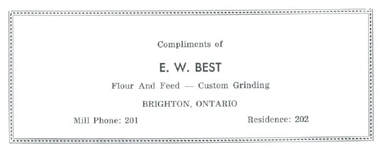
Mr. Best supported the creation of the book called “Centennial of the Incorporation of the Village of Brighton 1859 – 1959” by purchasing this add which appeared on page 72. It promoted his work at the grist mill with the description “Flour and Feed – Custom Grinding.” His grist mill operated until he retired in 1962. All of that time, he rented or leased the land where the mill was located. Because he was there for so long with a necessary and popular service, Ernie Best and his mill were commonly referred to in the community as a fixture you knew to be part of the landscape. People gave directions based on the Best Mill.
Village Lot 8, which appears to have been part of the property supporting 7 Dundas Street, was in the Nesbitt family from 1885 to 1971. This may represent the second building on that site, on the east side of the mill.
In 1962 Ernie Best retired and the grist mill at 7 Dundas Street was taken over by Gordon Kenneth Hanthorn (1913-1993) who was born at Coe Hill in Hastings County but had moved to Carrying Place with his family in the 1920s. His father, Joseph Hanthorn, was a blacksmith and Gordon’s brother Bill Hanthorn would evolve the blacksmithing business into a car repair shop, creating a fixture in Carrying Place known as Hanthorn’s Garage.
All of this time, the village lots were owned by the Proctor family. That changed in 1967 when the they sold the land in this area to Cy Boyce. The mill operated here until about 1970 when it was removed. The land in this area would become parking lot and driveway for the businesses on Prince Edward Street as well as for the library and municipal office.
Mr. Best supported the creation of the book called “Centennial of the Incorporation of the Village of Brighton 1859 – 1959” by purchasing this add which appeared on page 72. It promoted his work at the grist mill with the description “Flour and Feed – Custom Grinding.” His grist mill operated until he retired in 1962. All of that time, he rented or leased the land where the mill was located. Because he was there for so long with a necessary and popular service, Ernie Best and his mill were commonly referred to in the community as a fixture you knew to be part of the landscape. People gave directions based on the Best Mill.
Village Lot 8, which appears to have been part of the property supporting 7 Dundas Street, was in the Nesbitt family from 1885 to 1971. This may represent the second building on that site, on the east side of the mill.
In 1962 Ernie Best retired and the grist mill at 7 Dundas Street was taken over by Gordon Kenneth Hanthorn (1913-1993) who was born at Coe Hill in Hastings County but had moved to Carrying Place with his family in the 1920s. His father, Joseph Hanthorn, was a blacksmith and Gordon’s brother Bill Hanthorn would evolve the blacksmithing business into a car repair shop, creating a fixture in Carrying Place known as Hanthorn’s Garage.
All of this time, the village lots were owned by the Proctor family. That changed in 1967 when the they sold the land in this area to Cy Boyce. The mill operated here until about 1970 when it was removed. The land in this area would become parking lot and driveway for the businesses on Prince Edward Street as well as for the library and municipal office.
11 Dundas Street – The Singleton Homestead
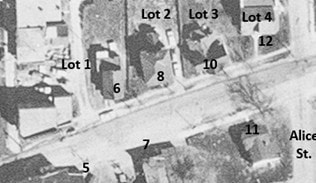
At this point, it might be useful to look at the 1960s aerial photo again. Here is a segment of the photo showing properties on both sides of Dundas Street west of Alice Street. Notice that the next property to the east is 11 Dundas Street, a significant building near the corner of Dundas and Alice Streets. The building is oriented to Dundas Street and not Alice Street and there is a significant yard between 11 and 7 Dundas.
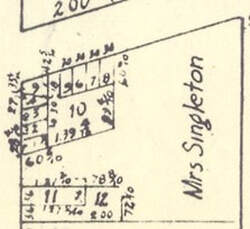
While this property appears rather non-descript, it is difficult to overstate the historical importance of this location and possibly the building itself. This was the location of the original Singleton homestead. This segment of the 1866 Brighton Plan shows that Mrs. Singleton is shown on the larger area west of Alice Street and south of Dundas Street.
In 1866, the name “Mrs. Singleton” referred to Margaret Singleton (1794-1886) who was the widow of John Singleton (1789-1837). We should recall that John Singleton was the son of George Singleton and Ann McArthur. His mother had come to the south end of Murray Township with her second husband, Alexander Chisholm around 1803 and they had lived close to Presqu’ile Bay.
In 1866, the name “Mrs. Singleton” referred to Margaret Singleton (1794-1886) who was the widow of John Singleton (1789-1837). We should recall that John Singleton was the son of George Singleton and Ann McArthur. His mother had come to the south end of Murray Township with her second husband, Alexander Chisholm around 1803 and they had lived close to Presqu’ile Bay.
However, when John Singleton married Margaret Canniff in 1811, this young couple established their home initially where John’s mother lived in Lot 35, Concession B, Murray Township. In 1815, he obtained the Patent from the Crown for 100 acres in the north end of lot 35, concession B. This was south of Elizabeth Street, adjacent to the land his mother would receive in 1825. In the ensuring years, he would sell pieces of land and village lots, especially along the east side of Prince Edward Street.
The obituary of Margaret (Canniff) Singleton in 1886 says that she lived in the house they had built when they moved to the area in April of 1815. That makes this property on the south-west corner of Dundas and Alice Streets one of the earliest homesteads in the area. The longevity of the house itself speaks to its role in the lives of the Singleton family. This also follows the reality that the name written on the largest part of this area in 1866 Brighton Plan was that of Margaret Singleton. That land included the Singleton homestead at the corner of Dundas and Alice Streets.
By the 1860s, the Singleton family had established itself father north, on the north side of Singleton Street, and would build a substantial brick home up the hill beside Young Street. In this context, Margaret Singleton and her daughter Lenora sold the property that was their old homestead at the corner of Dundas and Alice Streets, the transaction recorded in 1871.
William Coyle Sr. (1814-1876) was born in Scotland and married Mary McKenzie in Montrose, Scotland in 1842. One child, William Jr., was born in Scotland in 1843 before the family moved to Canada, first settling in Haldimand Township. Mary Coyle died there in 1852 and Wiliam Coyle Sr. married Ann ? before 1861, when the family is recorded in Brighton Township, in the Hilton area.
In the 1861 Census, William Coyle Jr. (1843-1898) is shown to be 18 but already described as a blacksmith, while his father is a labourer. In the next few years there would be three land acquisitions, all by William Coyle, with no designation of Sr. or Jr. In view of the circumstances, this historian feels that it was William Coyle Jr. who was engaged in the blacksmithing business and who purchased the land.
The obituary of Margaret (Canniff) Singleton in 1886 says that she lived in the house they had built when they moved to the area in April of 1815. That makes this property on the south-west corner of Dundas and Alice Streets one of the earliest homesteads in the area. The longevity of the house itself speaks to its role in the lives of the Singleton family. This also follows the reality that the name written on the largest part of this area in 1866 Brighton Plan was that of Margaret Singleton. That land included the Singleton homestead at the corner of Dundas and Alice Streets.
By the 1860s, the Singleton family had established itself father north, on the north side of Singleton Street, and would build a substantial brick home up the hill beside Young Street. In this context, Margaret Singleton and her daughter Lenora sold the property that was their old homestead at the corner of Dundas and Alice Streets, the transaction recorded in 1871.
William Coyle Sr. (1814-1876) was born in Scotland and married Mary McKenzie in Montrose, Scotland in 1842. One child, William Jr., was born in Scotland in 1843 before the family moved to Canada, first settling in Haldimand Township. Mary Coyle died there in 1852 and Wiliam Coyle Sr. married Ann ? before 1861, when the family is recorded in Brighton Township, in the Hilton area.
In the 1861 Census, William Coyle Jr. (1843-1898) is shown to be 18 but already described as a blacksmith, while his father is a labourer. In the next few years there would be three land acquisitions, all by William Coyle, with no designation of Sr. or Jr. In view of the circumstances, this historian feels that it was William Coyle Jr. who was engaged in the blacksmithing business and who purchased the land.
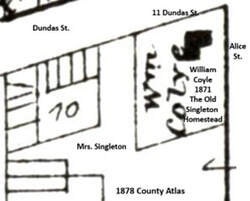
It began with a transaction on April 24, 1869, when William Coyle acquired village lot 19 on the south side of Dundas Street, east of Alice Street. The 1871 Census shows William Coyle Sr. and his wife Ann M. living by themselves in Brighton township. On the other hand, William Coyle Jr., and his wife Mary are in Brighton Village, where he is a blacksmith. Margaret Singleton and children are immediately above them on the page, and there are some Proctors below. This is the Dundas Street area, so I expect that William Coyle Jr. was living in the old Singleton house at the corner of Dundas and Alice Streets.
Then, on November 3, 1871, William Coyle Jr. purchased village lot 7 on the north side of Dundas, also just east of Alice Street. To finish the job, on November 13, 1871, William Coyle Jr. purchased land “south of Dundas Street and west of Lot 19” which may mean the land at the south-west corner of Dundas and Alice Streets. Certainly, the 1878 County Atlas map has him located there.
Then, on November 3, 1871, William Coyle Jr. purchased village lot 7 on the north side of Dundas, also just east of Alice Street. To finish the job, on November 13, 1871, William Coyle Jr. purchased land “south of Dundas Street and west of Lot 19” which may mean the land at the south-west corner of Dundas and Alice Streets. Certainly, the 1878 County Atlas map has him located there.
William Coyle Sr. died April 20, 1876 and William Coyle Jr. died November 20, 1898. In 1899, William Coyle’s children George and Albert registered a Quit Claim to their mother, Mary, for the property at the corner of Alice and Dundas Streets. In 1903 there is a very unusual item in the land records, called a “Caution” by the bank that held the mortgage regarding the estate of William Coyle Jr.
Then, in 1904, the Estate of William Coyle Jr. sold “part west of Alice and south of Dundas marked “Mrs. Singleton” on the plan” to Samuel Nesbitt. The path is not so clear after this, but it appears as if the property was sold in 1945 by Alice McLaren MacDonald to George & Lulu Dale. George Edwin Dale (1900-1954) was born in England and came to Canada with his parents in 1907 and they lived at 55 Alice Street. In 1928 he married Lulu Hazel Dingman and worked with the railway.
In 1949, George Dale sold this property to Albert Edward Jackson (1911-1984) who was born in London, England and came to Canada in 1929. He married Amy Jones in Hamilton in 1835 and came to Brighton before 1949 when he purchased several pieces of land south of Dundas Street and west of Alice Street in order to build and operate an auto body shop business. His home was here as well, probably in the old Singleton/Coyle/Dale house on the corner.
Then, in 1904, the Estate of William Coyle Jr. sold “part west of Alice and south of Dundas marked “Mrs. Singleton” on the plan” to Samuel Nesbitt. The path is not so clear after this, but it appears as if the property was sold in 1945 by Alice McLaren MacDonald to George & Lulu Dale. George Edwin Dale (1900-1954) was born in England and came to Canada with his parents in 1907 and they lived at 55 Alice Street. In 1928 he married Lulu Hazel Dingman and worked with the railway.
In 1949, George Dale sold this property to Albert Edward Jackson (1911-1984) who was born in London, England and came to Canada in 1929. He married Amy Jones in Hamilton in 1835 and came to Brighton before 1949 when he purchased several pieces of land south of Dundas Street and west of Alice Street in order to build and operate an auto body shop business. His home was here as well, probably in the old Singleton/Coyle/Dale house on the corner.
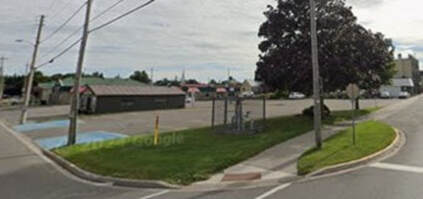
Jackson sold the body shop and home in 1956 and operated the Texaco gas station on Elizabeth Street for a time. The new owner of 11 Dundas Street was Stanley & Elma Hardy, but they sold in August of 1961 to Lorne and Nora Lockwood. Then, on November 24, 1961, 11 Dundas Street was purchased by Bruce and Blanche Zuber.
Bruce Anthony Zuber (1924-1976) was married to Blanche C. Mullen (1923-2012) on Jun 29 1946 in Walkerton, her home area. Bruce was from Hamilton and worked with the R.C.A.F.
These two are listed as the occupants of 11 Dundas Street in the 1965, 1968 and 1972 Canada Voters Lists. Bruce Zuber died November 5, 1976 and Blanche sold 11 Dundas St. to the Corporation of the Town of Brighton. This was at the time of the development of the new Brighton Municipal Office across Alice Street, which also included the library. At that point the location of one of the earliest homesteads in Brighton became a parking lot.
Bruce and Blanche Zuber were buried at Codrington Roman Catholic Cemetery.
Bruce Anthony Zuber (1924-1976) was married to Blanche C. Mullen (1923-2012) on Jun 29 1946 in Walkerton, her home area. Bruce was from Hamilton and worked with the R.C.A.F.
These two are listed as the occupants of 11 Dundas Street in the 1965, 1968 and 1972 Canada Voters Lists. Bruce Zuber died November 5, 1976 and Blanche sold 11 Dundas St. to the Corporation of the Town of Brighton. This was at the time of the development of the new Brighton Municipal Office across Alice Street, which also included the library. At that point the location of one of the earliest homesteads in Brighton became a parking lot.
Bruce and Blanche Zuber were buried at Codrington Roman Catholic Cemetery.
19 Dundas Street – Scotty Broughton Youth Centre
Today, there are no addresses on the south side of Dundas Street between Alice and Pinnacle Streets. The Brighton Municipal Office and the Brighton Public Library occupy the building on the south-east corner of Alice and Dundas Streets, but the address is 35 Alice Street, which is not within the scope of this work.
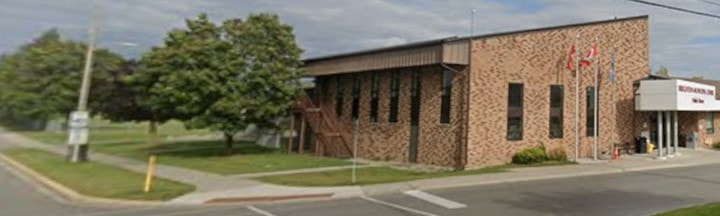
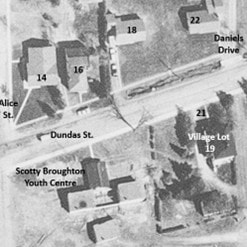
However, before we move on to Village Lot 19, farther down Dundas Street, let’s remember that there was an important building on Dundas Street in the area we can see today as the eastern parking lot for the Municipality and library complex.
The Scotty Broughton Youth Centre was opened on July 1, 1970 after much volunteer labour, fund raising and government support over a few years. J.W.D. “Scotty” Broughton was a journalist and war veteran who was extremely active in the boy scouts and other groups in the community. It was perfectly appropriate to name the new centre after him.
The structure began with a cottage brought from the lakeshore of Presqu’ile Point as they were removing cottages to expand the park. Soon after, three surplus portable classrooms from the public school were added to provide storage space and room for multiple activities. The centre was used for many community meetings and events and even hosted the courts which had been forced to leave the old town hall due to its deteriorating condition. The centre even hosted council chambers as well as the Ontario court which moved from below the library in 1972.
We can see this set of structures clearly in the aerial photo from the 1960s. The main building is the one with the dark roof which has a walkway out to Dundas Street. That is the cottage that came from Presqu’ile Point. The structures south of the main building are the portable classrooms that were added later.
The Scotty Broughton Youth Centre was opened on July 1, 1970 after much volunteer labour, fund raising and government support over a few years. J.W.D. “Scotty” Broughton was a journalist and war veteran who was extremely active in the boy scouts and other groups in the community. It was perfectly appropriate to name the new centre after him.
The structure began with a cottage brought from the lakeshore of Presqu’ile Point as they were removing cottages to expand the park. Soon after, three surplus portable classrooms from the public school were added to provide storage space and room for multiple activities. The centre was used for many community meetings and events and even hosted the courts which had been forced to leave the old town hall due to its deteriorating condition. The centre even hosted council chambers as well as the Ontario court which moved from below the library in 1972.
We can see this set of structures clearly in the aerial photo from the 1960s. The main building is the one with the dark roof which has a walkway out to Dundas Street. That is the cottage that came from Presqu’ile Point. The structures south of the main building are the portable classrooms that were added later.
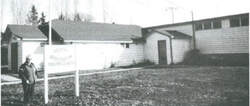
It is unclear to this historian whether the centre had a street address, but, if it did, it would likely have been 19 Dundas Street. Just speculation!
This facility existed for only about a decade, removed when the new municipal office was built on Alice Street in 1982. The Brighton Scouts would meet in the new building after that.
This facility existed for only about a decade, removed when the new municipal office was built on Alice Street in 1982. The Brighton Scouts would meet in the new building after that.
21 Dundas Street
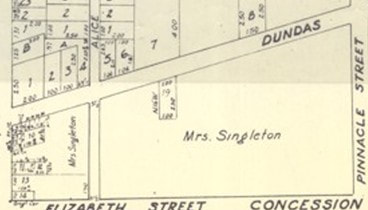
There is no 21 Dundas Street today, but there used to be. The 1866 Brighton Plan shows that lot 19 was located on the south side of Dundas Street about a third the way from Alice Street to Pinnacle Street.
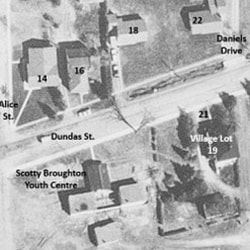
The aerial photo from the 1960s shows that lot 19 still existed at that time, with the border clearly marked out with a house, yard and trees. We can see that shrubs identified the border of this residential property.
The aerial photo from the 1960s shows that lot 19 still existed at that time, with the border clearly marked out with a house, yard and trees. We can see that shrubs identified the border of this residential property.
The history of village lot 19 is similar in its beginnings but different in later times. Of course, it all began with Ann Marsh obtaining the Patent from the Crown for all of lot 35, concession A, Murray Township in 1825. Then, in 1838, Ann and her son Archibald Chisholm granted lot 19 to her grandson, George Singleton, a son of John Singleton. We can look at the lots in this area on the north side of Dundas Street and see that George Singleton was very much involved.
A decade later, in 1848, George Singleton sold lot 19 to his half-brother Abraham C. Singleton (1817-1903), who remained single, but was very active in farming and real estate speculation. In 1852, he sold the lot to Charles Firman who sold it a decade later to Henry Phippen. In 1864, it went to James H. Vrooman and in 1869, it was sold to William Coyle Jr., a blacksmith who also acquired lot 7 on the north side of Dundas Street, as well as the old Singleton homestead at the south-west corner of Alice and Dundas Streets.
A decade later, in 1848, George Singleton sold lot 19 to his half-brother Abraham C. Singleton (1817-1903), who remained single, but was very active in farming and real estate speculation. In 1852, he sold the lot to Charles Firman who sold it a decade later to Henry Phippen. In 1864, it went to James H. Vrooman and in 1869, it was sold to William Coyle Jr., a blacksmith who also acquired lot 7 on the north side of Dundas Street, as well as the old Singleton homestead at the south-west corner of Alice and Dundas Streets.
William Coyle Jr. died in 1898 and a year later his sons, George and Albert quit claimed their interest in these properties to their widowed mother, Mary Coyle. The next transaction pertaining to lot 19 is a “Caution” in 1903 where the National Trust Company Ltd., the mortgage holder for this property, issued a caution related to “the estate of the late William Coyle”.
At this point, the land records under Lot 19, Brighton Village end, so we have to go back and look at the records for lot 35, Concession A, Brighton Township. Searching through these, this historian did not identify a connecting record after the caution. In this case, we look through and find things we know are for this property in later times, and trace the path backwards.
In 1953, it appears as if Arthur and Muriel Butters owned lot 19 and they sold it to James and Lillian Coletti. Arthur Hayden Butters (1908-1992) was born in Haldimand Township, a son of James Butters and Edith Brisbin. Around 1935 he married Muriel Alberta Macklin (1911-1999) and they lived in Brighton where he was involved in several businesses and a good deal of real estate speculation.
James Nicholas Coletti (1912-1986) was born in Toronto, a son of Anthony Coletti and Pearl Matilda Young. His mother, Pearl, was from Gardenville, Prince Edward County. James Coletti married his first wife, Kathleen McInerney, in 1935 and then his second, Lillian Winnifred Martin (1924-2018) around 1948. He was a contractor, for a time working with Tatham Construction in Carrying Place. He had owned 21 Dundas Street for only seven years, when he sold it to Emma Snider. Emma Pearce (1890-1970) was a daughter of Philip Pearce and Mary Gerow. She married Corey Snider (1882-1957) in 1907 and they lived in Smithfield. He worked as painter and decorator, but the family was very musical and Lenna, Norma and Ted grew up to love music. Lenna attended the Royal Conservatory of Music and then returned to Brighton to engage in a career as a music teacher. Her brother, Ted Snider, was a very popular band leader and radio personality.
At this point, the land records under Lot 19, Brighton Village end, so we have to go back and look at the records for lot 35, Concession A, Brighton Township. Searching through these, this historian did not identify a connecting record after the caution. In this case, we look through and find things we know are for this property in later times, and trace the path backwards.
In 1953, it appears as if Arthur and Muriel Butters owned lot 19 and they sold it to James and Lillian Coletti. Arthur Hayden Butters (1908-1992) was born in Haldimand Township, a son of James Butters and Edith Brisbin. Around 1935 he married Muriel Alberta Macklin (1911-1999) and they lived in Brighton where he was involved in several businesses and a good deal of real estate speculation.
James Nicholas Coletti (1912-1986) was born in Toronto, a son of Anthony Coletti and Pearl Matilda Young. His mother, Pearl, was from Gardenville, Prince Edward County. James Coletti married his first wife, Kathleen McInerney, in 1935 and then his second, Lillian Winnifred Martin (1924-2018) around 1948. He was a contractor, for a time working with Tatham Construction in Carrying Place. He had owned 21 Dundas Street for only seven years, when he sold it to Emma Snider. Emma Pearce (1890-1970) was a daughter of Philip Pearce and Mary Gerow. She married Corey Snider (1882-1957) in 1907 and they lived in Smithfield. He worked as painter and decorator, but the family was very musical and Lenna, Norma and Ted grew up to love music. Lenna attended the Royal Conservatory of Music and then returned to Brighton to engage in a career as a music teacher. Her brother, Ted Snider, was a very popular band leader and radio personality.
Lenna Lucy Snider (1915-2014) attended the Royal Conservatory of Music after graduating from E.N.S.S. and returned to Brighton to teach music. She had a long career as a beloved music teacher, choir leader and music enthusiast. In 1936, Lenna married George Arthur Alexander (1914-1954) and they had two children, one who died in infancy and Norma. In 1949, Lenna married Charles Morgan “Mike” Baker (1914- ) and they lived at 21 Dundas Street according to the 1965, 1968 and 1972 voters lists. Lenna had two children with Mike Baker, Marlene and Daniel.
The Canada Voters Lists demonstrate the presence of people at 21 Dundas Street in 1965, 1968 and 1972. In 1965, the occupants are Mrs. Emma Snider, a music teacher and Mr. and Mrs. Morgan Baker, he being a surveyor and she a music teacher. In 1968, the record is the same but in 1972, there are three listed in the Baker family, Morgan is a supervisor, Lenna is a music teacher and Daniel is a student. Also, 21 Dundas Street includes D.N.D. employee, George Thomas, his wife Maureen and G.C. Thomas who is a student.
It was not until 2006 that Lenna Baker sold the property at 21 Dundas Street to the municipality of Brighton. The buildings were removed and the land became part of the eastern-most parking lot for the municipal office and also the north-west corner of the public school grounds. Today, one would never know by looking at the spot that there was a residential property there for many years.
The Canada Voters Lists demonstrate the presence of people at 21 Dundas Street in 1965, 1968 and 1972. In 1965, the occupants are Mrs. Emma Snider, a music teacher and Mr. and Mrs. Morgan Baker, he being a surveyor and she a music teacher. In 1968, the record is the same but in 1972, there are three listed in the Baker family, Morgan is a supervisor, Lenna is a music teacher and Daniel is a student. Also, 21 Dundas Street includes D.N.D. employee, George Thomas, his wife Maureen and G.C. Thomas who is a student.
It was not until 2006 that Lenna Baker sold the property at 21 Dundas Street to the municipality of Brighton. The buildings were removed and the land became part of the eastern-most parking lot for the municipal office and also the north-west corner of the public school grounds. Today, one would never know by looking at the spot that there was a residential property there for many years.
71 Dundas Street – E.N.S.S.
The land on the south side of Dundas Street from the old Lot 19 to Terry Fox Drive is part of the grounds of Brighton Public School. This old softball player can easily recall playing ball on the ball diamond at the corner. Analysis of that property will be included in the section dealing with Elizabeth Street since the public school has an Elizabeth Street address.
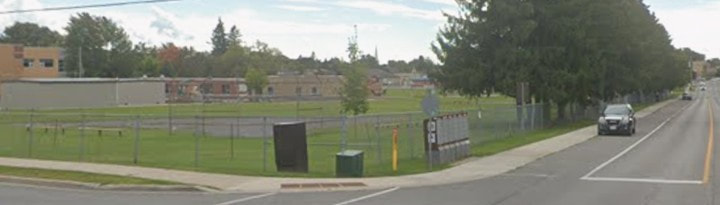
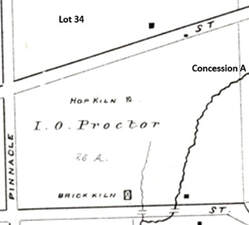
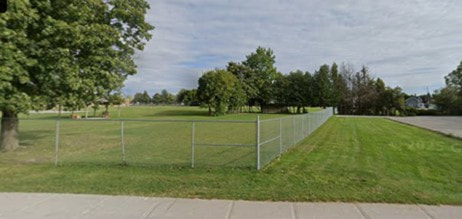
East of Terry Fox Drive we venture into the old Lot 34, Concession A, Brighton Township. The 1878 Belden County Atlas shows that what we call Terry Fox Drive was the southern extent of Pinnacle Street. This also means that, in order to find land records for this area, we must look into the township records and not the town records, or maybe both.
The next address to deal with is 71 Dundas Street, which is East Northumberland Secondary School.
The next address to deal with is 71 Dundas Street, which is East Northumberland Secondary School.
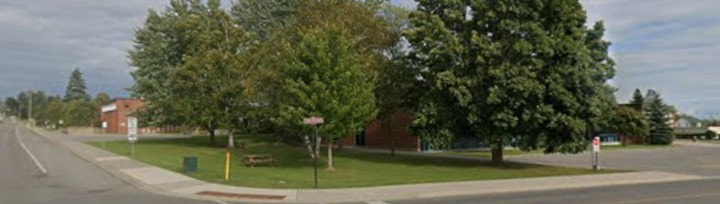
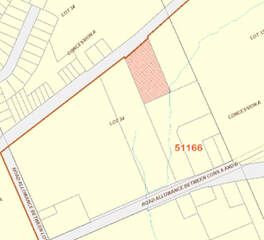
The map of this area in OnLand.ca shows that E.N.S.S. occupies the western part of the land south of Dundas Street in lot 34, with the exception of the small plaza at the corner of Terry Fox Drive and Elizabeth Street.
The history of this land began in 1828 with the Patent from the Crown for all 200 acres of lot 34, concession A, Murray Township going to Kings College. This means it was part of the reserved land that could generate revenue for the government when it was leased or sold.
The history of this land began in 1828 with the Patent from the Crown for all 200 acres of lot 34, concession A, Murray Township going to Kings College. This means it was part of the reserved land that could generate revenue for the government when it was leased or sold.
There may be records missing because the next transaction is the Will of Isaac C. Proctor in 1853. We know that the Proctors were busy in land acquisition in this period and it would be useful to know the path by which this lot came to Isaac C. Proctor. In any case, that is where we must take up the path. In this transaction, William C. Proctor, a son of Isaac, is to receive “part of the west quarter” which is not as specific as we might like. However, it gets more complicated because the same Will grants the “west half” to Isaac O. Proctor, another son. For the next several years, the two brothers exchange land and ultimately went to court where Isaac O. Proctor obtained the full 200 acres of lot 34.
The land may have been leased or rented to various tenants during the time this wrangling was going on, but the next event we can be certain about is in 1913 when Isaac O. Proctor sold the 200 acres of lot 34 to Samuel H. Tackaberry.
Samuel Harrison Tackaberry (1865-1941) was born in Watertown, New York, the son of Nathaniel Tackaberry and Eliza J. Vanwicklin. Details are thin regarding this family. We know that Eliza Jane Vanwicklin (1845-1885) was from Cramahe Township and was recorded in Brighton Township, age 19, in the 1861 Census. She appears to have married Nathaniel Tackaberry around 1864, although the location is not clear. Then, the 1871 Census shows Eliza as a widow living at Conc 2, Lot 8, Brighton Township, with her sister Lucinda and her son Sam. We do not know where Nathaniel and Eliza were married, where or when Nathaniel died or why Samuel was born in Watertown, New York.
There is a large group of Tackaberry families in the area of Hilton, Orland and Codrington around the same time, but there does not appear to be a direct connection between this Nathaniel Tackaberry and the several others of that group by the same name. This is very curious and more documentation for this problem would be welcome.
In any case, we know that Samuel H. Tackaberry grew up in Brighton Township, probably with his Vanwicklin relatives. His mother died in 1885 and he was married in 1890 to Sophia Ann Macklam (1865-1899) who was the daughter of Thomas Macklam and Elizabeth Mullett. Sophia had been married in 1884 to Alva Newton Metcalf who died in 1889 leaving one son, Bruce, from that marriage.
The land may have been leased or rented to various tenants during the time this wrangling was going on, but the next event we can be certain about is in 1913 when Isaac O. Proctor sold the 200 acres of lot 34 to Samuel H. Tackaberry.
Samuel Harrison Tackaberry (1865-1941) was born in Watertown, New York, the son of Nathaniel Tackaberry and Eliza J. Vanwicklin. Details are thin regarding this family. We know that Eliza Jane Vanwicklin (1845-1885) was from Cramahe Township and was recorded in Brighton Township, age 19, in the 1861 Census. She appears to have married Nathaniel Tackaberry around 1864, although the location is not clear. Then, the 1871 Census shows Eliza as a widow living at Conc 2, Lot 8, Brighton Township, with her sister Lucinda and her son Sam. We do not know where Nathaniel and Eliza were married, where or when Nathaniel died or why Samuel was born in Watertown, New York.
There is a large group of Tackaberry families in the area of Hilton, Orland and Codrington around the same time, but there does not appear to be a direct connection between this Nathaniel Tackaberry and the several others of that group by the same name. This is very curious and more documentation for this problem would be welcome.
In any case, we know that Samuel H. Tackaberry grew up in Brighton Township, probably with his Vanwicklin relatives. His mother died in 1885 and he was married in 1890 to Sophia Ann Macklam (1865-1899) who was the daughter of Thomas Macklam and Elizabeth Mullett. Sophia had been married in 1884 to Alva Newton Metcalf who died in 1889 leaving one son, Bruce, from that marriage.
Sophia Tackaberry gave birth to one son, Bause, who died as an infant, and Sophia died three years later in 1899. Then, in 1901, Samuel married Maude Mullett (1870-1918), who was born at Cannifton in Hastings County, the daughter of Daniel Haight Mullett and Cordelia Holt.
In the meantime, Samuel Tackaberry was working in the town of Brighton as a harness maker. In 1890, his wife, Sophia, purchased Village Lot 12 on the north side of Main Street, Brighton, where address 148 Main Street would later be identified. About a year later, Samuel and Sophia sold the same property to Lucinda McDonald. Both transactions were for $800. A few months later, Lucinda McDonald and husband sold the same property back to Samuel and Sophia for the same amount. We can only speculate what these exchanges were about. In any case, we can expect that Samuel Tackaberry may have lived at 148 Main Street, and may have built the brick house we see there today.
Four children were born to Samuel and Maude Tackaberry. Gladys Maud Tackaberry (1902-1994) remained unmarried until after she went to California where she met William J. West, and they would live at San Luis Obispo where Gladys died in 1994. Two sons were born to Samuel and Maude Tackaberry, Harrison in 1903 and Willard in 1906. They grew up on the farm and lived at 94 Dundas Street. Harrison Mullett Tackaberry (1903-1974) worked on the farm with his father and remained single. He is described as a farmer consistently in the records.
Willard Vanwicklin Tackaberry (1906-2000) also lived at home and worked the farm with his father and brother. In 1933, he married Muriel Mildren Young (1912-2005) who was born in Quebec, a daughter of Robert Young and Elizabeth Gray. This means that she is not related to any of the Young families in the area around Brighton. In 1935, Willard and Muriel had a son, Harry Ernest Tackaberry. Samuel and Maud’s fourth child, Hild Eliza, died in infancy in 1913.
In the meantime, Samuel Tackaberry was working in the town of Brighton as a harness maker. In 1890, his wife, Sophia, purchased Village Lot 12 on the north side of Main Street, Brighton, where address 148 Main Street would later be identified. About a year later, Samuel and Sophia sold the same property to Lucinda McDonald. Both transactions were for $800. A few months later, Lucinda McDonald and husband sold the same property back to Samuel and Sophia for the same amount. We can only speculate what these exchanges were about. In any case, we can expect that Samuel Tackaberry may have lived at 148 Main Street, and may have built the brick house we see there today.
Four children were born to Samuel and Maude Tackaberry. Gladys Maud Tackaberry (1902-1994) remained unmarried until after she went to California where she met William J. West, and they would live at San Luis Obispo where Gladys died in 1994. Two sons were born to Samuel and Maude Tackaberry, Harrison in 1903 and Willard in 1906. They grew up on the farm and lived at 94 Dundas Street. Harrison Mullett Tackaberry (1903-1974) worked on the farm with his father and remained single. He is described as a farmer consistently in the records.
Willard Vanwicklin Tackaberry (1906-2000) also lived at home and worked the farm with his father and brother. In 1933, he married Muriel Mildren Young (1912-2005) who was born in Quebec, a daughter of Robert Young and Elizabeth Gray. This means that she is not related to any of the Young families in the area around Brighton. In 1935, Willard and Muriel had a son, Harry Ernest Tackaberry. Samuel and Maud’s fourth child, Hild Eliza, died in infancy in 1913.
The situation changed dramatically when Samuel Tackaberry purchased all 200 acres of lot 34, concession A, Brighton Township on May 1, 1913. The purchase price is shown to be $10,000, a substantial amount of money in those days. The cost of the property included a farm house, barn and out-buildings that were on the north side of Dundas Street. The house still exists today, as 94 Dundas Street. Samuel was still described as a harness maker in the 1901 Census, but subsequent records say he was a farmer.
Samuel H. Tackaberry died July 4 1941 and the land was inherited by the three living children, Gladys, Harrison, Willard. Over several years in the 1940s and 1950s, these three sold parts of lot 34 to speculators and developers which resulted in a gas station at the corner of Elizabeth Street and the beginnings of housing developments north of Dundas Street.
Samuel H. Tackaberry died July 4 1941 and the land was inherited by the three living children, Gladys, Harrison, Willard. Over several years in the 1940s and 1950s, these three sold parts of lot 34 to speculators and developers which resulted in a gas station at the corner of Elizabeth Street and the beginnings of housing developments north of Dundas Street.
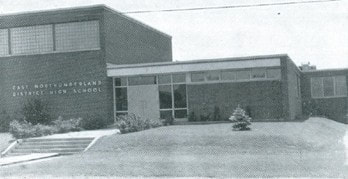
In 1954, Harrison Tackaberry and Gladys West granted part of lot 34 to Willard Tackaberry, excluding three parcels that had been sold to others in recent years. A few months later, on May 26, 1954, Willard Tackaberry sold 12 acres of his land south of Dundas Street to the East Northumberland District High School Board and that is where the new high school was built and opened in May of 1955.
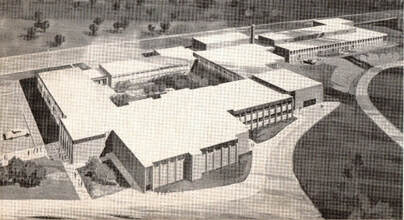
This historian attended E.N.S.S. from the fall of 1965 to the spring of 1970, in the days when grade 13 was still part of the process. My experience was completely with the building constructed in 1955, but just after I left, a major upgrade of the school took place, creating the extensive campus we see there today. I get lost easily in the place when I visit. In the fall of 2025, I was a guest speaker at the library to tell the story of Dr. King to the law class. Much fun there.
95 Dundas Street
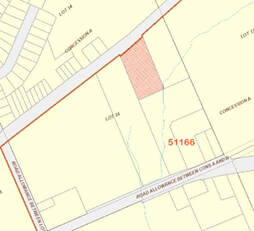
Immediately east of E.N.S.S. is a long, narrow property that goes from Elizabeth Street all the way to Dundas Street. Applefest Lodge and the McIntosh Apartments are at the south end and the building that hosts the OPP Station and the Agricultural Office is on the north end, at 95 Dundas Street.
The history of this property follows the path of 71 Dundas Street until 1959 when Willard Tackaberry sold land south of Dundas Street to the Ontario Ministry of Public Works. The high school land had been acquired in 1954, so this one in 1959, is definitely the land for the Agricultural Office.
The history of this property follows the path of 71 Dundas Street until 1959 when Willard Tackaberry sold land south of Dundas Street to the Ontario Ministry of Public Works. The high school land had been acquired in 1954, so this one in 1959, is definitely the land for the Agricultural Office.
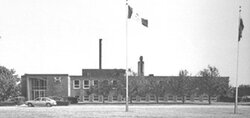
There was an Agricultural Office in Brighton, at 65 Main Street, from 1916 to 1960, which served the farmers of Northumberland County and was financed by the Ontario government. However, a new facility was required and the Agricultural Services Building was built. Ralph Bangay was the Agricultural Representative for Northumberland and he moved his staff into the new building from their pervious location on Main Street.
An article in the Brighton newspaper in April 1861 said “The Brighton Agriculture Office is to move to its new offices on Dundas. This Office opened in 1913 and was two years at Walter Davidson Block then moved down the street.”
An article in the Brighton newspaper in April 1861 said “The Brighton Agriculture Office is to move to its new offices on Dundas. This Office opened in 1913 and was two years at Walter Davidson Block then moved down the street.”
This is from a Brighton history book: “Attending the opening ceremonies were several dignitaries, among them R.G. Bennett, Chief Agricultural Office for Ontario, and the Hon. W.A. Goodfellow, Ontario’s Minister of Agriculture and Member of the Legislature for Northumberland County. Provisions were made for all the varied services of the Department. This was apparent when Mr. Banbury introduced his staff: H. Morley Webster, fruit and vegetable specialist; Ivy Loveless, senior secretary; Micheal Clitheroe, technician; Mrs Owen Finley, receptionist; John Cockrane, Assistant Agricultural representative; D. Owen Gibb, engineer; M.T. Napper, dairy inspector; and Clarence Wade, maintenance. Other employees over the years include - John Haggerty, soil and crop specialist; Jim Dalrymple, swine specialist; Grover Smith, weed inspector; Jim Doidge, milk tester; and Doug Young, Agriculture Representative.”
Dr. Richard Julian opened the Veterinarian laboratory in the lower level. His duties provided service to farmers in Eastern Ontario. Deceased animals were brought to the lab for postmortems to determine cause of death. It included testing chickens for disease. Dr. Doug Galt followed Dr. Julian and was joined by Dr. Brian Binnington, who continued after Dr. Galt was elected M.P.P. and until the lab was closed in 1995.
Dr. Richard Julian opened the Veterinarian laboratory in the lower level. His duties provided service to farmers in Eastern Ontario. Deceased animals were brought to the lab for postmortems to determine cause of death. It included testing chickens for disease. Dr. Doug Galt followed Dr. Julian and was joined by Dr. Brian Binnington, who continued after Dr. Galt was elected M.P.P. and until the lab was closed in 1995.
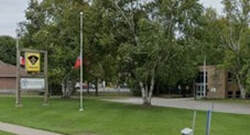
In 2000, the OPP office that was at 70 Young Street moved to occupy part of the building at 95 Dundas Street.
97 Dundas Street – Brighton Villas Condos
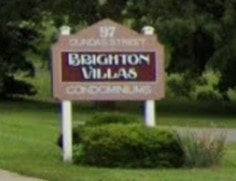
The next property is 97 Dundas Street which is Brighton Villas Condominiums.
The history of this property follows that of 71 and 95 until the 1950s. This was part of the land that Harrison and Gladys Tackaberry granted to their brother, Willard.
However, it was not until 1986 that Willard sold this property at the north end of the strip of land that is east of E.N.S.S. south of Dundas Street. It went to Venture Construction Inc. and by 1988, the condominium complex had been built and registered under the Condominium Act.
The history of this property follows that of 71 and 95 until the 1950s. This was part of the land that Harrison and Gladys Tackaberry granted to their brother, Willard.
However, it was not until 1986 that Willard sold this property at the north end of the strip of land that is east of E.N.S.S. south of Dundas Street. It went to Venture Construction Inc. and by 1988, the condominium complex had been built and registered under the Condominium Act.
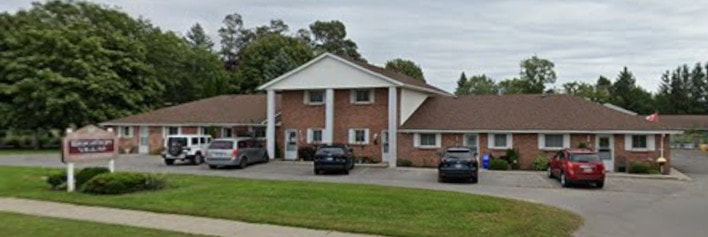
101 Dundas Street
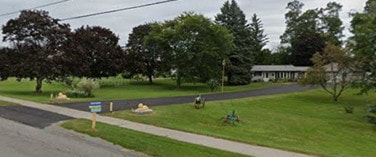
The next address is 101 Dundas Street which is a low-rise modern home set well back from the street behind a long driveway.
This was part of the land that Willard Tackaberry obtained from this brother Harrison and sister Gladys in 1954. Willard and Muriel would build a modern house here, across the street from the apple orchards.
This address does not appear in the 1965 and 1968 voters lists, but it does in 1972. This means that Willard and Muriel and Harrison were living at 94 Dundas St., the old farm house, until around 1970 when the house at 101 Dundas Street was built. Willard and Muriel moved in there, while Harrison stayed at the old house.
In 1987, Plan 38R-3894 defined 101 Dundas Street, and the next year, Willard transferred the property from him to both he and Muriel as Joint Tenants. Then, in 1993, Willard and Muriel granted the property to themselves as well as Nelson & Loretta Banting, as Joint Tenants. Willard Tackaberry died in 2000 and Nelson and Loretta Banting granted 101 Dundas to Harry and Margaret Tackaberry.
In 2009, Harry Tackaberry retired after 25 years as Fire Chief in Brighton.
This was part of the land that Willard Tackaberry obtained from this brother Harrison and sister Gladys in 1954. Willard and Muriel would build a modern house here, across the street from the apple orchards.
This address does not appear in the 1965 and 1968 voters lists, but it does in 1972. This means that Willard and Muriel and Harrison were living at 94 Dundas St., the old farm house, until around 1970 when the house at 101 Dundas Street was built. Willard and Muriel moved in there, while Harrison stayed at the old house.
In 1987, Plan 38R-3894 defined 101 Dundas Street, and the next year, Willard transferred the property from him to both he and Muriel as Joint Tenants. Then, in 1993, Willard and Muriel granted the property to themselves as well as Nelson & Loretta Banting, as Joint Tenants. Willard Tackaberry died in 2000 and Nelson and Loretta Banting granted 101 Dundas to Harry and Margaret Tackaberry.
In 2009, Harry Tackaberry retired after 25 years as Fire Chief in Brighton.
103 Dundas Street
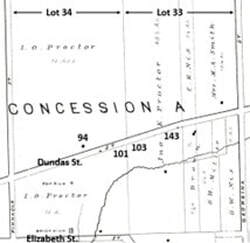
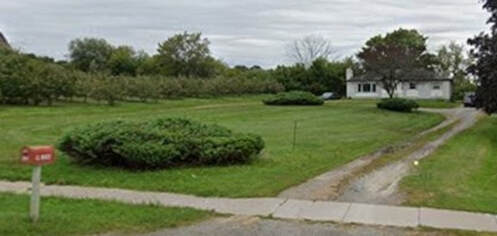
The next address is 103 Dundas Street, which is a modern house set back from the road with a long driveway. The name “R. Dunnett” is on the mailbox. This property is in lot 33, concession A, Brighton Township, and out of town far enough to represent the limits of this part of the “Around Town” project. However, the Dunnett property will be included in this section because they are also involved in the land to the west that was part of the Tackaberry farm.
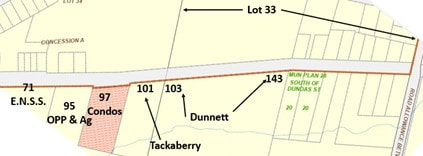
This property is a very recent development and was part of the Dunnett farm, so the history will be with #143 Dundas below.
The house at #103 was built for Robert Warren Dunnett (1946- ), the son of Arthur Dunnett and Dorothy Warren. He married Jean Muriel Gourley in 1971 and farmed with his father. A land transaction in 1971 transfers part of the Dunnett farm from Arthur to his son Robert for this purpose.
The house at #103 was built for Robert Warren Dunnett (1946- ), the son of Arthur Dunnett and Dorothy Warren. He married Jean Muriel Gourley in 1971 and farmed with his father. A land transaction in 1971 transfers part of the Dunnett farm from Arthur to his son Robert for this purpose.
In 1982, another transaction passed some of the farm to Robert Dunnett. Arthur Dunnett died in 1984 and Dorothy in 1990, after which her estate passed the remaining property of the farm to Robert Dunnett.
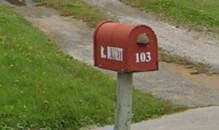
The mailbox at the road says “R. Dunnett – 103” There may be some confusion in the street numbers because the 1972 voters list shows Robert and M. Jean Dunnett living at 111 Dundas Street. A search in Google Maps for 111 Dundas Street, Brighton, lands at 103.
The mailbox at the road says “R. Dunnett – 103” There may be some confusion in the street numbers because the 1972 voters list shows Robert and M. Jean Dunnett living at 111 Dundas Street. A search in Google Maps for 111 Dundas Street, Brighton, lands at 103.

143 Dundas Street – The Dunnett Farm
The property at 143 Dundas Street is the farm including the house, barn and outbuildings. This snip of the Belden County Atlas of 1878 shows that #143 is just west of the halfway mark between the western half of lot 33 and the eastern half. At that time there was a homestead to the east from here, in lot 20, shown by black rectangles. This was not the Dunnett farm.
A snip from the OnLand.ca map shows that the modern organization of properties is similar to the original. South of Dundas Street, the Dunnett properties of #103 and #143 are in the west half of lot 33 and the east half is divided into several smaller lots. The properties east of Dunnett’s farm will be dealt with at a later date.
The history of Lot 33, Concession A, Murray (later Brighton) Township is very different from lot 34. The Patent from the Crown for the south 100 acres of lot 33 was granted to Joseph Forsyth in 1804, much earlier that the patent for lot 34 in 1825.
Joseph Forsyth (c1760-1813) was a primary merchant in Kingston who lobbied for and obtained significant land grants in Upper Canada. He was born in Scotland and was in Canada at some point before 1784. His name comes up in many land records around the Bay of Quinte area, in particular near the Carrying Place, all in this time period of the first few years of the 1800s. He was very active in land speculation to supplement his extensive trading and commercial enterprises.
Joseph Forsyth sold this property in 1812 to John Nix Sr. (1765-1853) who was born in New Jersey, a son of Hermanus Nix and Sophia Tice. This family were loyalists who came to Quebec in 1785 and soon after came to Ameliasburgh Township, settling in Cramahe Township by 1803. John Nix Sr. and son, John Nix Jr. were very active in the south end of Murray Township and were the builders of the first commercial wharf at the east end of Price Street in Gosport in 1841.
In 1815, John Nix Sr. granted the south part of lot 33 to his son, John Nix Jr. (1795-c1870) who was married to Sarah Ann Gibson, a daughter of George Gibson and Mary Randall of Newcastle on Presqu’ile Point. The property in lot 33 may have been leased or rented over the years because it contained some good farm land, but it is difficult to determine the state of the land in that period.
What we do know is that John Nix Jr. finally sold 50 acres in the south-west quarter of lot 33 to Isaac C. Proctor in 1851. Isaac Chamberlain Proctor (1790-1866) was a son of Josiah Proctor and Susanna Chamberlain, and the father of John Edward Proctor. John Nix Jr. was also involved in the wharf at Gosport and would sell that property to John Edward Proctor around the same time.
A snip from the OnLand.ca map shows that the modern organization of properties is similar to the original. South of Dundas Street, the Dunnett properties of #103 and #143 are in the west half of lot 33 and the east half is divided into several smaller lots. The properties east of Dunnett’s farm will be dealt with at a later date.
The history of Lot 33, Concession A, Murray (later Brighton) Township is very different from lot 34. The Patent from the Crown for the south 100 acres of lot 33 was granted to Joseph Forsyth in 1804, much earlier that the patent for lot 34 in 1825.
Joseph Forsyth (c1760-1813) was a primary merchant in Kingston who lobbied for and obtained significant land grants in Upper Canada. He was born in Scotland and was in Canada at some point before 1784. His name comes up in many land records around the Bay of Quinte area, in particular near the Carrying Place, all in this time period of the first few years of the 1800s. He was very active in land speculation to supplement his extensive trading and commercial enterprises.
Joseph Forsyth sold this property in 1812 to John Nix Sr. (1765-1853) who was born in New Jersey, a son of Hermanus Nix and Sophia Tice. This family were loyalists who came to Quebec in 1785 and soon after came to Ameliasburgh Township, settling in Cramahe Township by 1803. John Nix Sr. and son, John Nix Jr. were very active in the south end of Murray Township and were the builders of the first commercial wharf at the east end of Price Street in Gosport in 1841.
In 1815, John Nix Sr. granted the south part of lot 33 to his son, John Nix Jr. (1795-c1870) who was married to Sarah Ann Gibson, a daughter of George Gibson and Mary Randall of Newcastle on Presqu’ile Point. The property in lot 33 may have been leased or rented over the years because it contained some good farm land, but it is difficult to determine the state of the land in that period.
What we do know is that John Nix Jr. finally sold 50 acres in the south-west quarter of lot 33 to Isaac C. Proctor in 1851. Isaac Chamberlain Proctor (1790-1866) was a son of Josiah Proctor and Susanna Chamberlain, and the father of John Edward Proctor. John Nix Jr. was also involved in the wharf at Gosport and would sell that property to John Edward Proctor around the same time.
Then, in 1865, the 50 acres was sold to John Edward Proctor (1824-1911), a son of Isaac C. Proctor and Elizabeth Smith, married to Adelaide Victoria Weller. He was the builder of the big house on the hill north of Brighton that is now Proctor House Museum. John E. Proctor had ready cash and acted as seller of mortgages in the area, often taking over properties when people could not keep up with mortgage payments. The Proctor home on the hill was acquired in just such a situation. It caused the local community to have a rather negative opinion of the wealthy and aggressive Mr. Proctor.
Most of John Proctor’s land acquisitions were turned around for profit but this 50 acres in the south-west quarter of lot 33 remained in his possession until 1899 when it was passed to his son Charles Russell Weller Proctor (1871-1930) who was the manager of the Standard Bank in Brighton. He went to Calgary several times in the first few years of the 1900s in order to sell the extensive heard of purebred Herford cattle his father had developed on the Proctor farm. Charles Proctor made several trips to Calgary, taking loads of cattle on the train for sale to ranchers in Alverta. Later he was a bank manager in Edmonton, before returning to Brighton due to poor health.
During this time, Charles Proctor met Mona Louisa Wright (1884-1974), a daughter of Lt. Col. Joshua Wright and Elizabeth Brooks. Here father was a primary force in developing commercial enterprises in the Ottawa area. Starting in the later 1890s, Charles took over the management of the family business from this father who died in 1911. He would be very active in real estate transactions around Brighton.
In 1902, Charles Proctor sold the land in lot 33 that was marked with his father’s name to Alonzo Nathan Simpson (1858-1955), a son of John Simpson and Pheobe Huff, married to Harriett Russell. He was active in business in Brighton as was his son, Morley Simpson. Mr. Simpson turned the lot 33 property around immediately by selling to Albert Orliff “Bert” Maybee (1868-1951), the son of John Moses Maybee and Henrietta Lawson, married to 1st, Jessie Victoria Gartshore and 2nd Rose Fitchett.
A land transaction dated September 9, 1910 shows that Albert Maybee sold 150 acres in lot 33 to George Dunnett. Mr. Maybee was an active farmer and had purchased several pieces of land in lot 33, resulting in the total of 150 acres by 1910. George Dunnett (1860-1933) was born near Shiloh, Cramahe Twp., a son of Robert Dunnett and Mary Philp. He married Ella Maybee in 1889 and moved his young family to Brighton Township on the purchase of the farm in lot 33. Ella Maybee (1865-1946) was a sister of Albert Maybee.
Most of John Proctor’s land acquisitions were turned around for profit but this 50 acres in the south-west quarter of lot 33 remained in his possession until 1899 when it was passed to his son Charles Russell Weller Proctor (1871-1930) who was the manager of the Standard Bank in Brighton. He went to Calgary several times in the first few years of the 1900s in order to sell the extensive heard of purebred Herford cattle his father had developed on the Proctor farm. Charles Proctor made several trips to Calgary, taking loads of cattle on the train for sale to ranchers in Alverta. Later he was a bank manager in Edmonton, before returning to Brighton due to poor health.
During this time, Charles Proctor met Mona Louisa Wright (1884-1974), a daughter of Lt. Col. Joshua Wright and Elizabeth Brooks. Here father was a primary force in developing commercial enterprises in the Ottawa area. Starting in the later 1890s, Charles took over the management of the family business from this father who died in 1911. He would be very active in real estate transactions around Brighton.
In 1902, Charles Proctor sold the land in lot 33 that was marked with his father’s name to Alonzo Nathan Simpson (1858-1955), a son of John Simpson and Pheobe Huff, married to Harriett Russell. He was active in business in Brighton as was his son, Morley Simpson. Mr. Simpson turned the lot 33 property around immediately by selling to Albert Orliff “Bert” Maybee (1868-1951), the son of John Moses Maybee and Henrietta Lawson, married to 1st, Jessie Victoria Gartshore and 2nd Rose Fitchett.
A land transaction dated September 9, 1910 shows that Albert Maybee sold 150 acres in lot 33 to George Dunnett. Mr. Maybee was an active farmer and had purchased several pieces of land in lot 33, resulting in the total of 150 acres by 1910. George Dunnett (1860-1933) was born near Shiloh, Cramahe Twp., a son of Robert Dunnett and Mary Philp. He married Ella Maybee in 1889 and moved his young family to Brighton Township on the purchase of the farm in lot 33. Ella Maybee (1865-1946) was a sister of Albert Maybee.
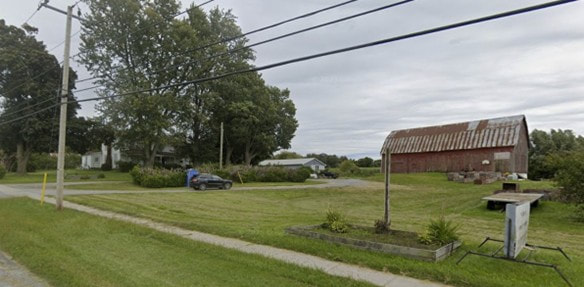
This transaction in 1910 marks the beginning of a long presence of the Dunnett family in Brighton, extending to the present day. One of the best known of the Dunnett family was Frank Henry Dunnett (1899-1989) who was a son of George Dunnett and Ella Maybee. After returning from service in World War I, Frank Dunnett studied to be a dentist and came back to Brighton to set up his dental practice. He married Edith Elizabeth Maybee (1901-1978) who was a daughter of Wesley Maybee and Nettie Bush.
In 1933, George Dunnett passed the farm to Arthur D. Dunnett, a son and so brother to the Dentist, Frank Dunnett. Arthur Douglas Dunnett (1893-1984) married 1st Ethel Marion Maybee (1903-1934) in 1926 and 2nd Dorothy Estella Warren (1907-1990) in 1941. He farmed with his father and lived at 143 Dundas St. By the way, Ethel, his first wife, was a sister of Edith who had married Frank Dunnett.
The Dunnett farm remained a fixture on Dundas Street on the east side of Brighton. In 1971, Arthur Dunnett granted land from the farm south of Dundas Street to his son Robert Warren Dunnett (1946- ) who married Jean Muriel Gourley, also in 1971. Robert continued with the farm and built a new modern house for his family just to the west of the Dunnett orchards that were beside the old farm house. The property was called 111 Dundas Street according to the 1972 voters list but now is #103, as is evident on the mailbox.
Arthur Dunnett passed away in 1984 and his wife Dorothy in 1990. In 1991, the last of the farm was passed to Robert Dunnett, as it remains today.
In 1933, George Dunnett passed the farm to Arthur D. Dunnett, a son and so brother to the Dentist, Frank Dunnett. Arthur Douglas Dunnett (1893-1984) married 1st Ethel Marion Maybee (1903-1934) in 1926 and 2nd Dorothy Estella Warren (1907-1990) in 1941. He farmed with his father and lived at 143 Dundas St. By the way, Ethel, his first wife, was a sister of Edith who had married Frank Dunnett.
The Dunnett farm remained a fixture on Dundas Street on the east side of Brighton. In 1971, Arthur Dunnett granted land from the farm south of Dundas Street to his son Robert Warren Dunnett (1946- ) who married Jean Muriel Gourley, also in 1971. Robert continued with the farm and built a new modern house for his family just to the west of the Dunnett orchards that were beside the old farm house. The property was called 111 Dundas Street according to the 1972 voters list but now is #103, as is evident on the mailbox.
Arthur Dunnett passed away in 1984 and his wife Dorothy in 1990. In 1991, the last of the farm was passed to Robert Dunnett, as it remains today.