The information about Dundas Street was published on February 5, 2026.
See the Introduction below, then go to the pages for the north and south sides of Dundas for the details on each property.
See the Introduction below, then go to the pages for the north and south sides of Dundas for the details on each property.
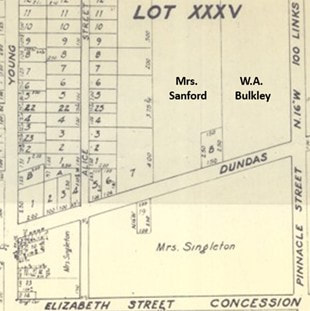
Dundas Street may be the oldest street in Brighton. It was part of the Danforth Road which was built from York to Kingston in 1799 and 1800. Today, Dundas Street appears to be separated from Main Street by the main intersection but, from 1800 to 1818, they both made up the Danforth Road in this place. At the border between Murray and Cramahe Townships, the road swung northerly to follow the higher ground to Smithfield, avoiding swampy areas to the south.
This means that, when the earliest settlers came to this area, the Danforth Road was the main thoroughfare and people wanted to establish their homes at convenient locations on the road. The Proctors made their homestead on the north side of the Danforth Road just east of today’s funeral home. The Proctor homestead was dealt with in the “Around Town” section on Main Street which has already been completed. The Singleton family established themselves east of Young and Prince Edward Streets and will be addressed during this history of Dundas Street.
This means that, when the earliest settlers came to this area, the Danforth Road was the main thoroughfare and people wanted to establish their homes at convenient locations on the road. The Proctors made their homestead on the north side of the Danforth Road just east of today’s funeral home. The Proctor homestead was dealt with in the “Around Town” section on Main Street which has already been completed. The Singleton family established themselves east of Young and Prince Edward Streets and will be addressed during this history of Dundas Street.
In order to do research on land registry records for Dundas Street, we need to recall that this area was east of Young Street, so in the original Murray Township, at Concession A, Lot 35. While village lots were created out of the township lot when Brighton Village was created in 1831, much of the land along Dundas Street was not divided into village lots. This can be seen clearly in the 1866 Brighton Plan which shows large sections south of Dundas Street labelled “Mrs. Singleton” and, farther east, sections north of Dundas Street labeled “Mrs. Sanford” and “W.A. Bulkley. The identity of these folks will be revealed in this study of Dundas Street.
The land records are organized by village lot, so where there is a village lot, such as the north side of Dundas from Young to Alice Streets, the work of finding the right transactions for each modern property has been done for us. However, where modern properties have been created out of the large sections with a person’s name applied, finding specific transactions for a modern property is tedious and time-consuming because it requires scanning through many pages of the township lot records and trying to decipher the names of the buyers and sellers, along with hand-written descriptions which might help to link transactions together in a path to the modern property. It is a challenge.
The land records are organized by village lot, so where there is a village lot, such as the north side of Dundas from Young to Alice Streets, the work of finding the right transactions for each modern property has been done for us. However, where modern properties have been created out of the large sections with a person’s name applied, finding specific transactions for a modern property is tedious and time-consuming because it requires scanning through many pages of the township lot records and trying to decipher the names of the buyers and sellers, along with hand-written descriptions which might help to link transactions together in a path to the modern property. It is a challenge.
The Patent from the Crown
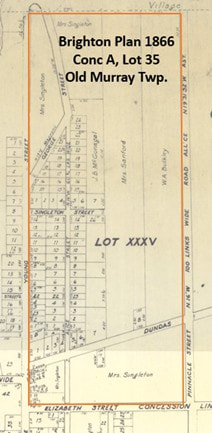
The Patent from the Crown for lot 35, concession A, Murray Township was granted to Anne Marsh on November 11, 1825. However, these patents were often a long time coming to the grantee. In this case, it is very clear that Anne Marsh had lived in the area since about 1803.
Ann “Nancy” McArthur (1771-c1863) was born in Kinderhook, Columbia County, New York, the daughter of Charles McArthur, a veteran of the War of Independence on the loyalist side. She was married to Capt. George Singleton in Quebec in 1788 and one son, John, was born the next year. Her husband was engaging in the fur trade at Singleton’s Creek, the modern site of Belleville, but died of fever while taking furs to Montreal in September 1789.
The widow Ann Singleton then married an associate of her husband’s, Col. Alexander Chisholm (1748-1808), a Scottish soldier with the British during the siege of Quebec in 1775. This fellow was very enterprising, with a skill for writing petitions to the authorities asking for land grants. When it became clear that he would not get land grants at Singleton’s Creek, he found unoccupied land farther west in Murray township, at the mouth of a creek along the north shore of Presqu’ile Bay which would later be call Butler Creek.
He built saw and grist mills at this site as early as 1797 and wrote many petitions begging for the land in lot 35, concession B, Murray Township to be granted to him in light of the improvements he had made. The petitions did not work but he was able to lease the land as an alternative.
Ann “Nancy” McArthur (1771-c1863) was born in Kinderhook, Columbia County, New York, the daughter of Charles McArthur, a veteran of the War of Independence on the loyalist side. She was married to Capt. George Singleton in Quebec in 1788 and one son, John, was born the next year. Her husband was engaging in the fur trade at Singleton’s Creek, the modern site of Belleville, but died of fever while taking furs to Montreal in September 1789.
The widow Ann Singleton then married an associate of her husband’s, Col. Alexander Chisholm (1748-1808), a Scottish soldier with the British during the siege of Quebec in 1775. This fellow was very enterprising, with a skill for writing petitions to the authorities asking for land grants. When it became clear that he would not get land grants at Singleton’s Creek, he found unoccupied land farther west in Murray township, at the mouth of a creek along the north shore of Presqu’ile Bay which would later be call Butler Creek.
He built saw and grist mills at this site as early as 1797 and wrote many petitions begging for the land in lot 35, concession B, Murray Township to be granted to him in light of the improvements he had made. The petitions did not work but he was able to lease the land as an alternative.
When Alexander Chisholm died in 1808, his widow married Cyrus Marsh, which resulted in the name Ann Marsh appearing in many land records in the area. Until her death around 1863, Ann Marsh would be extremely active in land transactions. As mentioned above, Ann Marsh received the Patent from the Crown for all 200 acres of lot 35, concession A, which is the land east of Young and Prince Edward Streets, north of Elizabeth Street and west of Pinnacle Street, and north to the extent of the lot in the area of Spring Valley.
We can speculate on where Ann Marsh lived in those early days. It makes sense that she and Alexander Chisholm lived near the mills on the north shore of Presqu’ile Bay. This couple had five children before Mr. Chisholm died in 1808, and these children would live with Ann and Cyrus Marsh in Concession B, Lot 34, Murray Township through the 1820s.
In the meantime, Ann’s son, John Singleton, had married Margaret Canniff in 1811 and obtained the Patent from the Crown in 1815 for 100 acres in the north end of lot 35, concession B. This was south of Elizabeth Street, adjacent to the land his mother would receive in 1825. In the ensuing years, he would sell pieces of land and village lots, especially along the east side of Prince Edward Street. The exactly location of the home of John and Margaret Singleton is not obvious, however, Margaret’s obituary in 1886, says that she lived in the house they had built when they moved to the area in April of 1815. It appears as if that was the house on the south-west corner of Dundas and Alice Streets, as will be explained later.
We can speculate on where Ann Marsh lived in those early days. It makes sense that she and Alexander Chisholm lived near the mills on the north shore of Presqu’ile Bay. This couple had five children before Mr. Chisholm died in 1808, and these children would live with Ann and Cyrus Marsh in Concession B, Lot 34, Murray Township through the 1820s.
In the meantime, Ann’s son, John Singleton, had married Margaret Canniff in 1811 and obtained the Patent from the Crown in 1815 for 100 acres in the north end of lot 35, concession B. This was south of Elizabeth Street, adjacent to the land his mother would receive in 1825. In the ensuing years, he would sell pieces of land and village lots, especially along the east side of Prince Edward Street. The exactly location of the home of John and Margaret Singleton is not obvious, however, Margaret’s obituary in 1886, says that she lived in the house they had built when they moved to the area in April of 1815. It appears as if that was the house on the south-west corner of Dundas and Alice Streets, as will be explained later.
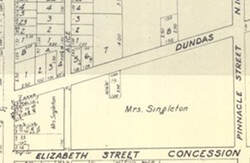
In 1834, John Singleton obtained 50 acres of the west half of the west half of lot 35, concession A, from his mother. This can be seen as the part of lot 35 along the east side of Young Street, north of Elizabeth Street, including the west end of Dundas Street. The halfway mark in lot 35 is about where the eastern edge of lot 7 is on the 1866 map. In fact, the Singleton family now owned the land along both sides of Dundas Street.