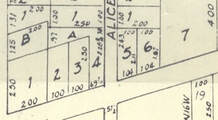
When Brighton village was established in 1831, village lots were created along the main streets in order to meet the growing demand for small lots to support commercial enterprise or for homes of tradesmen, professionals and retirees. At the corner of Dundas and Young Streets, the lot numbering system focussed more on Dundas Street than on Young Street. As a result, this segment of the Brighton Plan for 1866 shows the lots numbered from the corner at #1, to the east along the north side of Dundas Street. This means that the extra-large lot at the corner of Young and Dundas, lot 1, is included in the land registry records for Dundas Street north and not Young Street east.
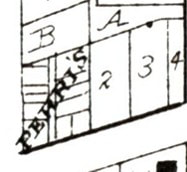
However, the Belden County Atlas map of 1878, only twelve years later, does not show lot 1, but documents its sub-division into small commercial spaces. From the 1840s, this corner at Dundas Street was considered an excellent location for business. While it was not on the primary east-west road, it was close enough to see travelers come off the road to do business here. In addition, the growing population in the rural areas to the north and east brought lots of farmers to this convenient spot. It was a good place to do business.
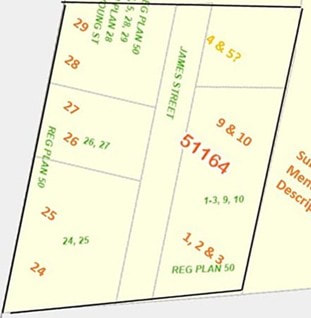
In 1868, Plan 50 was implemented in this area to create sub-divisions of lot 1. This segment of the larger map from the OnLand.ca system shows the old lot 1 at the corner of Dundas and Young. It identifies the properties fronting onto Young Street in two sections, starting at the corner, labelled sub-division lots 24 and 25, then north of there, 26 and 27. Lots 28 and 29 are in lot B to the north. These lots are all west of St. James Street, the small laneway off Dundas Street which also has properties on its east side.
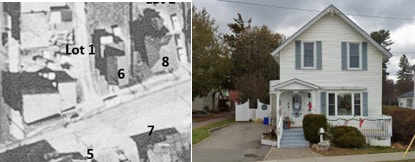
This subdivision of lots resulted in the modern situation of the property on the east side of James Street, in the south-east corner of the old lot 1, being called 6 Dundas Street.
This subdivision of lots resulted in the modern situation of the property on the east side of James Street, in the south-east corner of the old lot 1, being called 6 Dundas Street.
6 Dundas Street
The lovely frame house at 6 Dundas Street has James Street on its west side. Because it was part of the original lot 1, the history is different from the others along Dundas Street. All of them start with Ann Marsh who obtained the Patent from the Crown on November 11, 1825 and include the sale of the west half of the west half of lot 35 to her son, John Singleton.
Then, in 1835, John Singleton sold one half acre of lot 1 to James Taylor, a farmer in the south end of Murray Township who came to Brighton to conduct business. After James Taylor died in 1863, lot 1 was the subject of a Sherriff’s sale to Ephraim Doolittle, a farmer in Haldimand Township. He turned the property around quickly to James W. Cryderman, a farmer in Percy Township who then sold in 1864 to Mathew Ferris.
Mathew Ferris (1832-1893) was born in Ireland and came to Canada with several siblings in the 1850s, settling in Brighton. He was obviously a very capable and genial young fellow, because in 1860 he married Sarah Elizabeth Proctor (1839-1882) who was a daughter of Isaac Chamberlain Proctor and Elizabeth Smtih, so a sister of John Edward Proctor. He would engage as a merchant for several decades, building a large dry goods store on the south-east corner of Dundas and Prince Edwards Streets as well as a two-story commercial building on the north corner of Dundas and Young.
The commercial building was at the corner of Young and Dundas and it is not clear how the south-east corner of lot 1 was used during this time. In 1891 a fire destroyed the Ferris dry goods store on the south corner of Dundas Street. Mr. Ferris did not rebuild and sold the property to the Proctors who built their large hotel. The commercial building on the north corner was removed in the 1890s as well and in 1899 was sold to Charles M. Sanford.
Mathew Ferris (1832-1893) was born in Ireland and came to Canada with several siblings in the 1850s, settling in Brighton. He was obviously a very capable and genial young fellow, because in 1860 he married Sarah Elizabeth Proctor (1839-1882) who was a daughter of Isaac Chamberlain Proctor and Elizabeth Smtih, so a sister of John Edward Proctor. He would engage as a merchant for several decades, building a large dry goods store on the south-east corner of Dundas and Prince Edwards Streets as well as a two-story commercial building on the north corner of Dundas and Young.
The commercial building was at the corner of Young and Dundas and it is not clear how the south-east corner of lot 1 was used during this time. In 1891 a fire destroyed the Ferris dry goods store on the south corner of Dundas Street. Mr. Ferris did not rebuild and sold the property to the Proctors who built their large hotel. The commercial building on the north corner was removed in the 1890s as well and in 1899 was sold to Charles M. Sanford.
Charles Marcus Sanford (1862-1916) was a son of Thomas Dorman Sanford and Harriet Butler. He served as a doctor in Brighton for several decades. Like many members of wealthy families, Charles Sanford engaged in real estate speculation and development in a growing town. In the 1890s he acquired the old lot 1 and built a new two-story commercial building on the corner.
Charles Sanford leased and sold many small pieces of the old lot 1, as a profit could be realized. In 1907, he sold several small lots on the east side of lot 1 to Nancy Dingman. Nancy Chatterson (1858-1928) was a daughter of Alexander Albert Chatterson and Emily Jane Tripp. In 1876 she married Norman D. Dingman. They were farmers in Cramahe Township, but moved to Brighton where he engaged in the grocery business. Charles Sanford paid $500 for the land in 1899 and Nancy Dingman paid $1,400 for it in 1907, possibly indicating a house had been built on the south-east corner of lot 1, facing onto Dundas Street. When the postal system provided numbered addresses on the streets, this would be 6 Dundas Street.
Nancy Dingman passed away in 1928 and her estate sold the property she owned from old lot 1, including 6 Dundas St., to Clarence Sherwood, who was speculating in land. He died in 1946 and the property passed to his sister, Ethel Ross. Ethel Maud Sherwood (1883-1967) was a sister of Clarence Sherwood who was married to Samuel David Ross (1887-1966), who was an active salesman and merchant in Brighton. Ethel and Samuel were married in 1905, his second and her first marriage.
In 1960, 6 Dundas Street was sold to Ted Hennessey. Edward C. “Ted” Hennessey (c1932- ) was a son of Bert Hennessey and Greta Baird, from a farm family in Murray Township. Bert had come to Brighton to do business and one of his main enterprises was an auto repair shop at 20 Young Street, where young Ted carried on with business after his father passed. Ted was married to Cherie Frances Ross (1931-2013), daughter of Charles Valleau Ross and Margaret May McComb from north of Codrington.
Mr. Hennessey sold the property in 1964 to Marie J. G. Derasp, who is shown living at 6 Dundas St. in the 1965 voters list. In 1968, she sold to Doreen Alice (Rowe) O’Keefe, the wife of John O’Keefe. This couple and their daughter Deborah are shown to be living at 6 Dundas Street for the 1972 voters lists.
In 1999, Doreen O’Keefe sold the property to Sandra Elizabeth Hay. Sandra Elizabeth Chatten (1956- ) is a daughter of Earl Chatten and Liz Raney, married in 1978 to Walter Reginald Hay.
Charles Sanford leased and sold many small pieces of the old lot 1, as a profit could be realized. In 1907, he sold several small lots on the east side of lot 1 to Nancy Dingman. Nancy Chatterson (1858-1928) was a daughter of Alexander Albert Chatterson and Emily Jane Tripp. In 1876 she married Norman D. Dingman. They were farmers in Cramahe Township, but moved to Brighton where he engaged in the grocery business. Charles Sanford paid $500 for the land in 1899 and Nancy Dingman paid $1,400 for it in 1907, possibly indicating a house had been built on the south-east corner of lot 1, facing onto Dundas Street. When the postal system provided numbered addresses on the streets, this would be 6 Dundas Street.
Nancy Dingman passed away in 1928 and her estate sold the property she owned from old lot 1, including 6 Dundas St., to Clarence Sherwood, who was speculating in land. He died in 1946 and the property passed to his sister, Ethel Ross. Ethel Maud Sherwood (1883-1967) was a sister of Clarence Sherwood who was married to Samuel David Ross (1887-1966), who was an active salesman and merchant in Brighton. Ethel and Samuel were married in 1905, his second and her first marriage.
In 1960, 6 Dundas Street was sold to Ted Hennessey. Edward C. “Ted” Hennessey (c1932- ) was a son of Bert Hennessey and Greta Baird, from a farm family in Murray Township. Bert had come to Brighton to do business and one of his main enterprises was an auto repair shop at 20 Young Street, where young Ted carried on with business after his father passed. Ted was married to Cherie Frances Ross (1931-2013), daughter of Charles Valleau Ross and Margaret May McComb from north of Codrington.
Mr. Hennessey sold the property in 1964 to Marie J. G. Derasp, who is shown living at 6 Dundas St. in the 1965 voters list. In 1968, she sold to Doreen Alice (Rowe) O’Keefe, the wife of John O’Keefe. This couple and their daughter Deborah are shown to be living at 6 Dundas Street for the 1972 voters lists.
In 1999, Doreen O’Keefe sold the property to Sandra Elizabeth Hay. Sandra Elizabeth Chatten (1956- ) is a daughter of Earl Chatten and Liz Raney, married in 1978 to Walter Reginald Hay.
8 Dundas Street
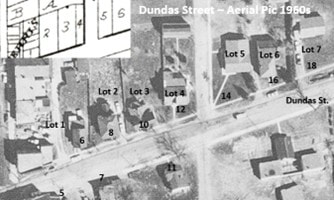
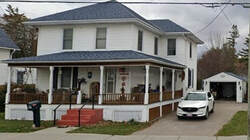
Today, 8 Dundas Street presents an impressive two-story house with a charming wrap-around veranda. The driveway is on the east side of the house with a small garage at the north-east corner of the house.
This is the first property east of the old lot 1, so it is in lot 2, as we can see in the map segment. The history of this property is very different from those to the west and similar to those to the east. The first two land transactions are similar to lot 1, but the path changes after that.
This is the first property east of the old lot 1, so it is in lot 2, as we can see in the map segment. The history of this property is very different from those to the west and similar to those to the east. The first two land transactions are similar to lot 1, but the path changes after that.
John Singleton died in 1837 and much of his land was inherited by his wife and children. This particular area was obtained by George Singleton (1815-1892) who married Catharine Sparrow in 1843.
In 1858, George Singleton sold Village Lot 2, Dundas Street North to Joseph Ellison Lockwood (1835-1901) who was son of Joseph Lockwood and Elizabeth Detlor. His father was named the first postmaster of Brighton when the village was created in 1831 and he held that position for five decades. The name of the village was attributed to him as it was the custom for the postmaster to provide a name for a new post office. His parents had come from Brighton, England, and the committee agreed with the postmaster’s recommendation.
Joseph Lockwood assigned the mortgage on this property to Alexander Martin in 1868 and Martin then sold the property to Thomas Campbell Lockwood (1827-1914), Joseph’s brother. It is difficult to know whether Joseph Lockwood lived at Lot 2 or just made an investment, but the fact that it passed to his brother might suggest at least some of the Lockwood family lived here. Joseph appears to have been involved in lot 3 as well and was in Brighton into the early 1880s, but would leave the area, and die in Sudbury in 1901.
In 1858, George Singleton sold Village Lot 2, Dundas Street North to Joseph Ellison Lockwood (1835-1901) who was son of Joseph Lockwood and Elizabeth Detlor. His father was named the first postmaster of Brighton when the village was created in 1831 and he held that position for five decades. The name of the village was attributed to him as it was the custom for the postmaster to provide a name for a new post office. His parents had come from Brighton, England, and the committee agreed with the postmaster’s recommendation.
Joseph Lockwood assigned the mortgage on this property to Alexander Martin in 1868 and Martin then sold the property to Thomas Campbell Lockwood (1827-1914), Joseph’s brother. It is difficult to know whether Joseph Lockwood lived at Lot 2 or just made an investment, but the fact that it passed to his brother might suggest at least some of the Lockwood family lived here. Joseph appears to have been involved in lot 3 as well and was in Brighton into the early 1880s, but would leave the area, and die in Sudbury in 1901.
Thomas C. Lockwood sold Lot 2 to Alexander Waldie (1828-1915) in 1886. He was a Scot who had immigrated to Canada with his family in 1833. Around 1866 he married Mary Ann Covell (1833-1913) and daughter of David Covell and Maria Nix, and they lived in Brighton.
In 1898 Alexander Waldie sold lot 2 to Corintha A. (Allard) Freeman (1849-1927) who was a daughter of Henry Sanford Allard and Catherine Smith Lawson, farmers at the south end of Murray Township. Corintha had married Sylvanus Freeman Jr. in 1871 and he operated a barber shop on Young Street, later involved in the grocery business. They were also very much engaged in real estate speculation in the growing town of Brighton. About a year after the purchase, Corintha and Sylvanus Freeman sold lot 2 to William Wallace Porte (1859-1937) who was a prosperous jeweler in town and much involved in real estate transactions. In 1904, he turned lot 2 around to Laura E. Bulkley.
Laura Emily Bulkley (1880-1958) was a daughter of William Andrew Bulkely and Emily Phillips. She married George Newcomb Gordon in 1907 – his mother was Elizabeth Newcomb of the Newcomb Mills family of millers. Laura moved the property quickly to George Wesley Peister (1863-1906) a son of Andrew Peister and Elizabeth Brown, who farmed near Smithfield. He married Elizabeth Hardcastle in 1888 and they farmed with his family until retiring to Brighton.
George Peister died in 1945 and his estate sold lot 2, now designated as 8 Dundas St., to Gordon and Thomas Locklin, sons of Ralph Locklin and Anna May Peister, a daughter of George W. Peister. The property was quickly sold on to John and Hilda Hadwen. John Herbert Hadwen (1890-1979) was born in Vaughan Twp. and his family went to Saskatchewan, where he married Hilda Kemp. They returned to Ontario and farmed near Castleton.
In 1898 Alexander Waldie sold lot 2 to Corintha A. (Allard) Freeman (1849-1927) who was a daughter of Henry Sanford Allard and Catherine Smith Lawson, farmers at the south end of Murray Township. Corintha had married Sylvanus Freeman Jr. in 1871 and he operated a barber shop on Young Street, later involved in the grocery business. They were also very much engaged in real estate speculation in the growing town of Brighton. About a year after the purchase, Corintha and Sylvanus Freeman sold lot 2 to William Wallace Porte (1859-1937) who was a prosperous jeweler in town and much involved in real estate transactions. In 1904, he turned lot 2 around to Laura E. Bulkley.
Laura Emily Bulkley (1880-1958) was a daughter of William Andrew Bulkely and Emily Phillips. She married George Newcomb Gordon in 1907 – his mother was Elizabeth Newcomb of the Newcomb Mills family of millers. Laura moved the property quickly to George Wesley Peister (1863-1906) a son of Andrew Peister and Elizabeth Brown, who farmed near Smithfield. He married Elizabeth Hardcastle in 1888 and they farmed with his family until retiring to Brighton.
George Peister died in 1945 and his estate sold lot 2, now designated as 8 Dundas St., to Gordon and Thomas Locklin, sons of Ralph Locklin and Anna May Peister, a daughter of George W. Peister. The property was quickly sold on to John and Hilda Hadwen. John Herbert Hadwen (1890-1979) was born in Vaughan Twp. and his family went to Saskatchewan, where he married Hilda Kemp. They returned to Ontario and farmed near Castleton.
Again, very quickly, 8 Dundas Street was sold to Lilliam E. Goodrich who was the second wife of Frank Goodrich. Records suggest that Donald Morgan and his wife rented 8 Dundas Street, at least in 1965. Later that year, Lillian Goodrich sold the property to Clarence and Alice Hadwen. Clarence Stanley Hadwen (1928-2017) was a son of John Herbert Hadwen and Hilda Kemp, born when they were in Saskatchewan and then returned to Brighton. In 1952 he married Alice Mae Trottman and he was a civil servant in Brighton. This Hadwen family is shown to be living at 8 Dundas Street according to the 1968 and 1972 voters lists.
The last land transaction available for 8 Dundas Street shows that Clarence and Alice Hadwen sold to Daniel McIvor in 2002.
The last land transaction available for 8 Dundas Street shows that Clarence and Alice Hadwen sold to Daniel McIvor in 2002.
10 Dundas Street
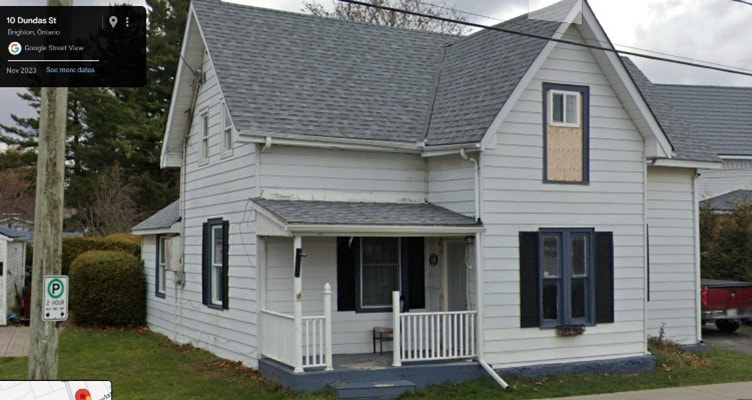
The white frame house at 10 Dundas Street is in Village Lot 3. Like Lot 2, it was acquired by George Singleton, but lot 3 was sold to Margare F. Lockwood in 1843. Margaret Fraser Lockwood (1815-1876) was a sister of Joseph and Thomas Lockwood who would marry Rev. William Coleman (1808-1879) in 1951. They lived on Lot 3 for a time but then Rev. Coleman was assigned to Brock township, Ontario County, and later went to Toronto.
|
William and Margaret Coleman sold lot 3 in 1866 to Elizabeth Lockwood, Margaret’s mother. In 1876 Elizabeth, now a widow, sold it to Mary Ann (Boutellier) Lockwood (1836-1901), the wife of Joseph E. Lockwood.
Two years later, Joseph and Mary Ann Lockwood sold lot 3 to Isaac Oscar Proctor who sold back to Mary Ann Lockwood a year later. Then, 1882, Joseph and Mary sold the property to Alexander Waldie, who would also acquire lot 2 in 1886. |
|
The next step is a bit uncertain based on what we see in the records. In 1897 Alexander Waldie sold lot 3 to Jenette Waldie. There is no Jenette Waldie in the records, but this may refer to Jenette McDonald ((1856-1919) from Consecon who married Robinson Marshall (1850-1932) a couple we see in the following records.
Robinson Marshall (1850-1932) was the son of James Marshall and Rebecca Robinson, farmers in Clarke Township, Durham County. Jenette McDonald (1856-1919) was a daughter of David McDonald and Margaret Munroe and was born at Consecon, Prince Edward County. Mr. Marshall was a harness maker in Brighton.
In 1904, Robinson and Jenette Marshall sold lot 3 to William Charles Marshall (1878-1950), their eldest child. In 1902 he had married Bertha Louise Covell (1880-1973) who was a daughter of John Simeon Covell and Amanda Quick. William and Bertha moved to Toronto.
Only a few months later, Lot 3 was sold to Alfred Gunyo (1868-1935) was a son of Asa Gunyo and Phoebe Quick, who in 1890 married Mary Jane Riley. Mr. Gunyo was well known as a long-time grocery merchant in Brighton and as an avid hunter and fisherman. He moved to Gosport in 1915 and had a campsite on Presqu’ile Point.
Alfred Gunyo died in 1935 and the property at 10 Dundas Street went to his wife, Jennie. She died in early 1954 and her estate sold it to Nancy M. Gunyo and Margaret A. Smith. Nancy Mae Latta (1898-1983) was a daughter of Jonathan & Margaret Latta and she had married Stuart Alfred Gunyo (1899-1956), a son of Alfred Gunyo and Jennie Riley, in Toronto in 1921. Margaret A. Smith was their daughter who was married to Donald Smith and lived in Marmora. It appears as if Stuart and Nancy were divorced and he married Irene E. Little who appears with him in cemetery records. Nancy remained as Nancy Gunyo and appears in many records in Brighton until her death in 1983. She is buried with her Latta family in Victoria Cemetery, Thurlow Twp.
There is no entry for 10 Dundas Street in the 1965 voters lists, but land records show that Nancy Gunyo and Margaret Smith sold 10 Dundas Street in 1967 to Leonard and Agnes MacGregor, who are living there in 1968 and 1972. In 2001 they sold 10 Dundas Street to John and Catharine Brunton.
Robinson Marshall (1850-1932) was the son of James Marshall and Rebecca Robinson, farmers in Clarke Township, Durham County. Jenette McDonald (1856-1919) was a daughter of David McDonald and Margaret Munroe and was born at Consecon, Prince Edward County. Mr. Marshall was a harness maker in Brighton.
In 1904, Robinson and Jenette Marshall sold lot 3 to William Charles Marshall (1878-1950), their eldest child. In 1902 he had married Bertha Louise Covell (1880-1973) who was a daughter of John Simeon Covell and Amanda Quick. William and Bertha moved to Toronto.
Only a few months later, Lot 3 was sold to Alfred Gunyo (1868-1935) was a son of Asa Gunyo and Phoebe Quick, who in 1890 married Mary Jane Riley. Mr. Gunyo was well known as a long-time grocery merchant in Brighton and as an avid hunter and fisherman. He moved to Gosport in 1915 and had a campsite on Presqu’ile Point.
Alfred Gunyo died in 1935 and the property at 10 Dundas Street went to his wife, Jennie. She died in early 1954 and her estate sold it to Nancy M. Gunyo and Margaret A. Smith. Nancy Mae Latta (1898-1983) was a daughter of Jonathan & Margaret Latta and she had married Stuart Alfred Gunyo (1899-1956), a son of Alfred Gunyo and Jennie Riley, in Toronto in 1921. Margaret A. Smith was their daughter who was married to Donald Smith and lived in Marmora. It appears as if Stuart and Nancy were divorced and he married Irene E. Little who appears with him in cemetery records. Nancy remained as Nancy Gunyo and appears in many records in Brighton until her death in 1983. She is buried with her Latta family in Victoria Cemetery, Thurlow Twp.
There is no entry for 10 Dundas Street in the 1965 voters lists, but land records show that Nancy Gunyo and Margaret Smith sold 10 Dundas Street in 1967 to Leonard and Agnes MacGregor, who are living there in 1968 and 1972. In 2001 they sold 10 Dundas Street to John and Catharine Brunton.
12 Dundas Street
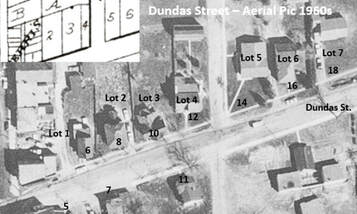
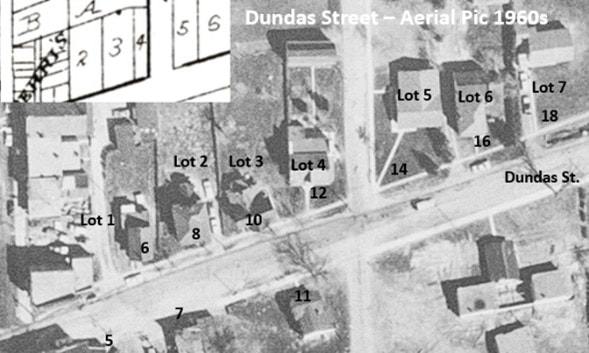
The property at 12 Dundas Street occupies Village Lot 4 which is on the north-west corner of Dundas and Alice Streets, with the house facing south onto Dundas Street and Alice Street along its east side. The aerial photo from the 1960s shows us that the house is aligned with Alice Street and not Dundas Street.
From a historical perspective, Village Lots 4 through 7 on the north side of Dundas Street are significant because they were owned by members of the Singleton family into the later 1800s. The original Singleton homestead was on the south side of the road, at what became 11 Dundas Street, and these four lots are another example of the long presence of the Singleton family in Brighton.
From a historical perspective, Village Lots 4 through 7 on the north side of Dundas Street are significant because they were owned by members of the Singleton family into the later 1800s. The original Singleton homestead was on the south side of the road, at what became 11 Dundas Street, and these four lots are another example of the long presence of the Singleton family in Brighton.
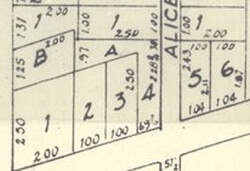
Lot 4 was part of lot 35, concession A, Murray Township that was inherited by George Singleton, a son of John and Margaret Singleton. In 1841, he sold lot 4 to his brother, Abraham, and in 1852, Abraham sold it to his mother, Margaret Singleton. In 1859, Margaret passed it along to her son George, so it had come full circle. There was a lot of this kind of land maneuvering in the Singleton family.
Then, in 1859, George Singleton sold lot 4 to Peter L. Sparrow, his brother-in-law. Peter’s father, Joseph Sparrow had a large family in Percy Twp. They may have gone to the US because in 1872 Peter Sparrow sold lot 4 to Catherine Singleton, his sister and the wife of George Singleton. It may be interesting to note that, according to the 1866 Brighton Plan, lot 4 appears to be extended north into lot A, which spreads behind lots 2, 3 and 4. This was resolved before the 1878 Belden County Atlas which shows lot 4 with a clear northern border.
Then, in 1859, George Singleton sold lot 4 to Peter L. Sparrow, his brother-in-law. Peter’s father, Joseph Sparrow had a large family in Percy Twp. They may have gone to the US because in 1872 Peter Sparrow sold lot 4 to Catherine Singleton, his sister and the wife of George Singleton. It may be interesting to note that, according to the 1866 Brighton Plan, lot 4 appears to be extended north into lot A, which spreads behind lots 2, 3 and 4. This was resolved before the 1878 Belden County Atlas which shows lot 4 with a clear northern border.
A very interesting sentence appears in Susan Brose’s book about the History of Brighton Businesses, on page 319: “Brighton in 1855: On Dundas Street the Post Office was in the house now occupied by Mr. Alf Gunyo and next door where Mr. Tom Cheer now lives was Singleton's bakery. Opposite was the old Singleton homestead.”
Let’s parse this a bit. This was in the newspaper in 1944. At that time, Alfred Gunyo lived at 10 Dundas Street, the second house west of Alice Street. Next door, at 12 Dundas Street, was Thomas Cheer, at the corner of Alcie and Dundas Streets. This text says that 12 Dundas Street was originally the bakery of the Singleton family.
Then it says “Opposite was the old Singleton homestead.” From this we can pinpoint the exact location of the original Singleton homestead as the south-west corner of Alice and Dundas Streets, which today is the parking lot for the library and municipal office. This is where the first Singleton homestead was located. See 11 Dundas Street, on the south side, for more details.
Then, in 1884, George and Catherine Singleton passed lot 4 on to their son, Walter Singleton (1855-1945). He Married Sarah Emma Morden (1859-1929) in 1879 and they would soon move to Colorado. Several land transactions in Brighton were accomplished from a distance as Walter Singleton sold Lot 4 in 1896 to Thomas Henry Cheer (1861-1943). He was a son of Henry Cheer and Lucinda Victoria Davidson. In 1890 he married Mary Ellen Haynes in Cobourg and they lived in Brighton where he engaged in various businesses, such as the sale of coal and farm implements as well as gardening.
Let’s parse this a bit. This was in the newspaper in 1944. At that time, Alfred Gunyo lived at 10 Dundas Street, the second house west of Alice Street. Next door, at 12 Dundas Street, was Thomas Cheer, at the corner of Alcie and Dundas Streets. This text says that 12 Dundas Street was originally the bakery of the Singleton family.
Then it says “Opposite was the old Singleton homestead.” From this we can pinpoint the exact location of the original Singleton homestead as the south-west corner of Alice and Dundas Streets, which today is the parking lot for the library and municipal office. This is where the first Singleton homestead was located. See 11 Dundas Street, on the south side, for more details.
Then, in 1884, George and Catherine Singleton passed lot 4 on to their son, Walter Singleton (1855-1945). He Married Sarah Emma Morden (1859-1929) in 1879 and they would soon move to Colorado. Several land transactions in Brighton were accomplished from a distance as Walter Singleton sold Lot 4 in 1896 to Thomas Henry Cheer (1861-1943). He was a son of Henry Cheer and Lucinda Victoria Davidson. In 1890 he married Mary Ellen Haynes in Cobourg and they lived in Brighton where he engaged in various businesses, such as the sale of coal and farm implements as well as gardening.
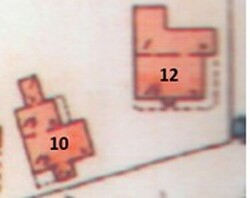
In 1899 Thomas Cheer passed Lot 4 to his wife Mary E. Cheer and in 1918, it went back to her husband. It is interesting to note that the 1926 Brighton Fire Map shows a rather substantial house at the corner of Alice and Dundas Streets. The house is placed a bit back from Dundas and aligned with Alice Street. This was most likely a house that was built by the Singletons many years before.
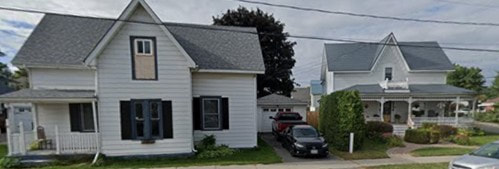
This contrasts with the more modern house we see at the corner in the 1960s aerial photo and the image we see today of the two houses at 10 and 12 Dundas Street.
This contrasts with the more modern house we see at the corner in the 1960s aerial photo and the image we see today of the two houses at 10 and 12 Dundas Street.
The estate of Thomas Henry Cheer sold 12 Dundas Street in 1947 to Lionel Alfred Dale (1903-1982). He was a son of Edwin Stonehouse Dale and Emma King, immigrants from England in 1907. They lived at 55 Alice Street and Edwin worked as a stationman at the Grant Trunk Railway station. Lionel Dale remained unmarried.
The 1965 voters list shows Lionel Dale living at 12 Dundas Street at that time, along with his brother Arthur Dale and their older sister Christine Catton. The sister is there alone in the 1968 list and Lionel is listed as a pensioner in the 1972 list.
In 1983, the estate of Lionel Dale passed 12 Dundas Street to his brother Claude Crawford Dale (1813-1989) who married Betty Lorraine Dusenbury in 1940. Ron Dale was their son.
In 1989 Betty Lorraine Dale sold the property to Mirjana Bachich.
The 1965 voters list shows Lionel Dale living at 12 Dundas Street at that time, along with his brother Arthur Dale and their older sister Christine Catton. The sister is there alone in the 1968 list and Lionel is listed as a pensioner in the 1972 list.
In 1983, the estate of Lionel Dale passed 12 Dundas Street to his brother Claude Crawford Dale (1813-1989) who married Betty Lorraine Dusenbury in 1940. Ron Dale was their son.
In 1989 Betty Lorraine Dale sold the property to Mirjana Bachich.
14 Dundas Street
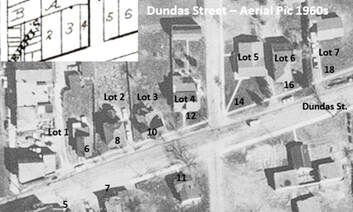
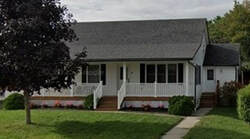
The property at 14 Dundas Street occupies Village Lot 5, on the north-east corner of Dundas and Alice Streets, with the house facing south onto Dundas Street but the driveway off Alice Street.
From a historical perspective, Village Lots 4 through 7 on the north side of Dundas Street are significant because they were owned by members of the Singleton family into the later 1800s. The original Singleton homestead was on the south side of the road, at what became 11 Dundas Street, and these four lots are another example of the long presence of the Singleton family in Brighton.
From a historical perspective, Village Lots 4 through 7 on the north side of Dundas Street are significant because they were owned by members of the Singleton family into the later 1800s. The original Singleton homestead was on the south side of the road, at what became 11 Dundas Street, and these four lots are another example of the long presence of the Singleton family in Brighton.
The history of Village Lot 5 is similar to lot 4, but different in several ways. Ann Marsh and her son, A. C. Chisholm sold lot 5 to George Singleton in 1838. This was 35 years after they came to the area.
A very interesting sentence appears in Susan Brose’s book about the History of Brighton Businesses, on page 319: “Brighton in 1855: On Dundas Street the Post Office was in the house now occupied by Mr. Alf Gunyo and next door where Mr. Tom Cheer now lives was Singleton's bakery. Opposite was the old Singleton homestead.”
Let’s parse this a bit. This was in the newspaper in 1944. At that time, Alfred Gunyo lived at 10 Dundas Street, the second house west of Alice Street. Next door, at 12 Dundas Street was Thomas Cheer, at the corner of Alcie and Dundas Streets. This text says that 12 Dundas Street was originally the baker of the Singleton family.
Then it says “Opposite was the old Singleton homestead.” From this we can pinpoint the exact location of the original Singleton homestead as the south-west corner of Alice and Dundas Streets, which today is the parking lot for the library and municipal office. This is where the first Singleton homestead was located. See 11 Dundas Street, on the south side, for more details.
Twenty-three years later, in 1861, a mortgage issue was worked out and lot 5 went to Margaret Singleton, widow of John Singleton. She remained very active in real estate, often with her single daughter Leonora Emily Singleton (1822-1909).
A very interesting sentence appears in Susan Brose’s book about the History of Brighton Businesses, on page 319: “Brighton in 1855: On Dundas Street the Post Office was in the house now occupied by Mr. Alf Gunyo and next door where Mr. Tom Cheer now lives was Singleton's bakery. Opposite was the old Singleton homestead.”
Let’s parse this a bit. This was in the newspaper in 1944. At that time, Alfred Gunyo lived at 10 Dundas Street, the second house west of Alice Street. Next door, at 12 Dundas Street was Thomas Cheer, at the corner of Alcie and Dundas Streets. This text says that 12 Dundas Street was originally the baker of the Singleton family.
Then it says “Opposite was the old Singleton homestead.” From this we can pinpoint the exact location of the original Singleton homestead as the south-west corner of Alice and Dundas Streets, which today is the parking lot for the library and municipal office. This is where the first Singleton homestead was located. See 11 Dundas Street, on the south side, for more details.
Twenty-three years later, in 1861, a mortgage issue was worked out and lot 5 went to Margaret Singleton, widow of John Singleton. She remained very active in real estate, often with her single daughter Leonora Emily Singleton (1822-1909).
In 1868, Margaret Singleton sold lot 5 to Catharine Singleton, wife of George Singleton and in 1884, they passed it to their son, Walter Singleton. A few months later, the property went to Mary M. J. Singleton (1850-?) as sister of George Singleton. There is no information for this Mary Singleton after the 1891 Census., except for the land transaction in 1899 where she sells this land to George F. Singleton (1851-1916) who was a son of George and Catharine Singleton. He went to Michigan in 1878 and married Mary Lydia Houghton. The next year, the 1880 census shows this couple in Park Co., Colorado where George is a book keeper and Mary’s father Jacob Houghton, is a mining supervisor. The couple remained childless and spent most of their lives in Minneapolis where George worked as a telegraph operator.
Lot 5 was turned around quickly by George F. Singleton, selling to Mary E. Cheer, wife of Thomas Cheer, who also had lot 4. In 1918 the land went to Thomas Cheer and it was 1943 before his estate sold it to Edmond Glasby Dale (1907-1994), a son of Edwin Stonehouse Dale and Emma King. The family were immigrants from England in 1907. They lived at 55 Alice Street and Edwin worked as a stationman at the Grant Trunk Railway station. Edmond Glasby Dale married Beatrice McMurter in 1937 and their son was Gerald Dale.
Just three years later, lot 5 was sold to Joan and Annie Whelan. Annie Ola Ferguson (1914-1998) was born in Bomanton, Haldimand Twp. (near Grafton) the daughter of William James Ferguson and Lena May Stevens. In 1932 she married Ivan Orval Whalen who was from Leeds County. There is no information about Joan, but she may be a sister.
Lot 5 was turned around quickly by George F. Singleton, selling to Mary E. Cheer, wife of Thomas Cheer, who also had lot 4. In 1918 the land went to Thomas Cheer and it was 1943 before his estate sold it to Edmond Glasby Dale (1907-1994), a son of Edwin Stonehouse Dale and Emma King. The family were immigrants from England in 1907. They lived at 55 Alice Street and Edwin worked as a stationman at the Grant Trunk Railway station. Edmond Glasby Dale married Beatrice McMurter in 1937 and their son was Gerald Dale.
Just three years later, lot 5 was sold to Joan and Annie Whelan. Annie Ola Ferguson (1914-1998) was born in Bomanton, Haldimand Twp. (near Grafton) the daughter of William James Ferguson and Lena May Stevens. In 1932 she married Ivan Orval Whalen who was from Leeds County. There is no information about Joan, but she may be a sister.
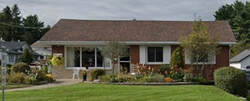
Sixteen years later, in 1962, lot 5 was sold to Frank and Lillian Goodrich. Frank Everett Goodrich (1895-1969) was a son of Stephen Goodrich and Ida McDonald and he was a grandson of Robert Goodrich, the first grist mill operator at Dundonald in Cramahe Township. He married Eva Alice Walker in 1920 and farmed in Cramahe Township until around 1947 when he moved to Brighton to take over the “Cheer Yard Mill on Dundas Street South, west of Alice St.” Records suggest that the family lived at 14 Dundas St. for a time before buying the property in 1962.
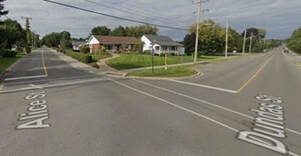
Lillian appears to be the second wife of Frank Goodrich, although her identity is not clear for this historian right now. Eva died in 1959 and the voters list for 1962 shows Frank and Mrs. Frank living in Brighton, although the 1965 list shows only Frank at 14 Dundas Street. The 1968 list shows both of them. Frank died in 1969.
In 1971, the estate of Frank Goodrich sold lot 5 to David and Beatrice Geddes and they are shown to be living at 14 Dundas St., he is listed as “D.N.D.”, meaning employed at Trenton Forces Base. In 1974, they sold to Gerald and Emma Casey and they are at the same place in 1996.
In 1971, the estate of Frank Goodrich sold lot 5 to David and Beatrice Geddes and they are shown to be living at 14 Dundas St., he is listed as “D.N.D.”, meaning employed at Trenton Forces Base. In 1974, they sold to Gerald and Emma Casey and they are at the same place in 1996.
16 Dundas Street
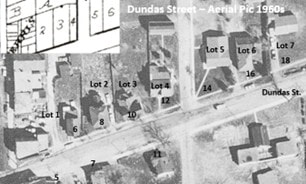
The property at 16 Dundas Street occupies Village Lot 6 which is one east of the north-east corner of Dundas and Alice Streets. The house faces south onto Dundas Street, relatively close to the street, with the driveway on the west side, in between #16 and #14.
Note that #16, shows as 16A and16B in the Canada Voters Lists, suggesting a duplex or two apartments.
Note that #16, shows as 16A and16B in the Canada Voters Lists, suggesting a duplex or two apartments.
From a historical perspective, Village Lots 4 through 7 on the north side of Dundas Street are significant because they were owned by members of the Singleton family into the later 1800s. The original Singleton homestead was on the south side of the road, at what became 11 Dundas Street, and these four lots are another example of the long presence of the Singleton family in Brighton.
The history of Village Lot 6 is similar to lots 4 and 5, but different in several ways. Ann Marsh and her son, A. C. Chisholm sold lot 6 to George Singleton in 1838. This was 35 years after they came to the area.
The history of Village Lot 6 is similar to lots 4 and 5, but different in several ways. Ann Marsh and her son, A. C. Chisholm sold lot 6 to George Singleton in 1838. This was 35 years after they came to the area.
A very interesting sentence appears in Susan Brose’s book about the History of Brighton Businesses, on page 319: “Brighton in 1855: On Dundas Street the Post Office was in the house now occupied by Mr. Alf Gunyo and next door where Mr. Tom Cheer now lives was Singleton's bakery. Opposite was the old Singleton homestead.”
Let’s parse this a bit. This was in the newspaper in 1944. At that time, Alfred Gunyo lived at 10 Dundas Street, the second house west of Alice Street. Next door, at 12 Dundas Street was Thomas Cheer, at the corner of Alcie and Dundas Streets. This text says that 12 Dundas Street was originally the baker of the Singleton family.
Then it says “Opposite was the old Singleton homestead.” From this we can pinpoint the exact location of the original Singleton homestead as the south-west corner of Alice and Dundas Streets, which today is the parking lot for the library and municipal office. This is where the first Singleton homestead was located. See 11 Dundas Street, on the south side, for more details.
Twenty-three years later, in 1861, a mortgage issue was worked out and lot 6 went to Margaret Singleton, widow of John Singleton. She remained very active in real estate, often with her single daughter Leonora Emily Singleton (1822-1909).
Let’s parse this a bit. This was in the newspaper in 1944. At that time, Alfred Gunyo lived at 10 Dundas Street, the second house west of Alice Street. Next door, at 12 Dundas Street was Thomas Cheer, at the corner of Alcie and Dundas Streets. This text says that 12 Dundas Street was originally the baker of the Singleton family.
Then it says “Opposite was the old Singleton homestead.” From this we can pinpoint the exact location of the original Singleton homestead as the south-west corner of Alice and Dundas Streets, which today is the parking lot for the library and municipal office. This is where the first Singleton homestead was located. See 11 Dundas Street, on the south side, for more details.
Twenty-three years later, in 1861, a mortgage issue was worked out and lot 6 went to Margaret Singleton, widow of John Singleton. She remained very active in real estate, often with her single daughter Leonora Emily Singleton (1822-1909).
In 1872, Margaret Singleton sold lot 6 to Catharine Singleton, wife of George Singleton and in 1884, they passed it to their son, Walter Singleton. Two years later, the property went to Mary M. J. Singleton (1850-?) a sister of George Singleton. There is no information for this Mary Singleton after the 1891 Census., except for the land transaction in 1899 where she sells this land to George F. Singleton (1851-1916) who was a son of George and Catharine Singleton. He went to Michigan in 1878 and married Mary Lydia Houghton. The next year, the 1880 census shows this couple in Park Co., Colorado where George is a book keeper and Mary’s father Jacob Houghton, is a mining supervisor. The couple remained childless and spent most of their lives in Minneapolis where George worked as a telegraph operator.
Lot 6 was turned around in six months by George F. Singleton, selling to Mary E. Cheer, wife of Thomas Cheer, who also had lot 4 and 5. Thomas Henry Cheer (1861-1943) was a son of Henry Cheer and Lucinda Victoria Davidson. In 1890 he married Mary Ellen Haynes in Cobourg and they lived in Brighton where he engaged in various business, such as coal, farm implements and gardening.
Then, in 1905, Thomas and Mary Cheer sold lot 6 to William R. Ainsworth. William Burton Ainsworth (1880-1948) was a son of Edgar Philmore Ainsworth and Mary Emma Sills who had a farm west of Brighton on what is No. 2 Highway today. In 1900 he married Charlotte Van Blaricom. W.B. Ainsworth is mentioned a good deal in Presqu’ile history as being a fog horn engineer during the time in the 1920s when the coal-fired fog horn operated in conjunction with the light house to protect shipping into Presqu’ile Bay.
Lot 6 was turned around in six months by George F. Singleton, selling to Mary E. Cheer, wife of Thomas Cheer, who also had lot 4 and 5. Thomas Henry Cheer (1861-1943) was a son of Henry Cheer and Lucinda Victoria Davidson. In 1890 he married Mary Ellen Haynes in Cobourg and they lived in Brighton where he engaged in various business, such as coal, farm implements and gardening.
Then, in 1905, Thomas and Mary Cheer sold lot 6 to William R. Ainsworth. William Burton Ainsworth (1880-1948) was a son of Edgar Philmore Ainsworth and Mary Emma Sills who had a farm west of Brighton on what is No. 2 Highway today. In 1900 he married Charlotte Van Blaricom. W.B. Ainsworth is mentioned a good deal in Presqu’ile history as being a fog horn engineer during the time in the 1920s when the coal-fired fog horn operated in conjunction with the light house to protect shipping into Presqu’ile Bay.
Less than a year later, William R. Ainsworth sold lot 6 to Sarah J. Brooks. Sarah Jane Brooks (1839-1910) was the daughter of Samuel Brooks and Margaret Asselstine who farmed in Murray, later Brighton Township. They owned Lots 8 & 9 on the east side of Young Street for a time. Sarah remained unmarried but engaged in real estate speculation with family resources.
Six months later, the estate of Sarah Jane Brooks sold the property to her brother, William Brooks (1837-1920) who was married to Tryphena Jane Nix (1849-1918). The estate of William Brooks sold lot 6 in 1923 to John Pake and Vera Goodrich. John Elgin Pake (1869-1945) was a son of Samuel Pake and Ryanna Walt who wee farmers in the area. In 1896 he married Emma Augusta Smith (1868-1950) from Prince Edward County. They lived in Brighton and he was an agent for an oil company. Vera Pearl Pake (1897-1952) was a daughter of John Elgin Pake and Emma Smith. She married 1st Leon Ernest Goordrich in 1915 and them Albert Edward Cline in 1934. Vera lived in Brighton.
In 1935, the estate of John Pake and Vera Goodrich sold lot 6 to Elva Ross. Edith Elva Waite (1875-1963) was a daughter of Willet Casey Waite and Emma Jane Bedal, farmers in Cramahe Township. In 1896 she married Robert James Ross (1876-1967) who was a very active merchant in Brighton.
In 1946 Edith Ross sold the property to Ivan O. & Annie O. Whalen. Ivan Orval Whalen (1911-2001) was born in Leeds Co., eastern Ontario and married Annie Ola Ferguson (1914-1998) in 1932. They both died in Cobourg. Then, in 1962, the Whalens sold it to Lillian Goodrich, second wife of Frank Goodrich, who also had lot 5. The 1965 votes list shows two tenants at this location. Mrs. Ruby Pellerin, a clerk, was at 16A Dundas St. and John Smith, John, labourer was at 16B Dundas St.
In 1966, Lillian Goodrich sold lot 6 to Edwin and Teresa Semple. Edwin James Semple (1927-2015) was a son of William Russell Semple and Ellen Naomi Nash Portway, of the Semple family of Gosport. About 1948 he married Teresa May Smuck and they would live in Brighton. He is shown in 1965 as a carpenter and in 1968 as a plant supervisor. The Semple family are shown at 16 Dundas Street in the 1968 voters list.
Then, in 1971, Edwin and Teresa Semple sold lot 6 to Iva L. Patterson. Ivy Lillian Miller (1927-2015) was born in Picton, married Frederick Patterson and lived in Trenton. This couple, along with Sharon Patterson are at 16 Dundas Street for the 1972 voters list.
Six months later, the estate of Sarah Jane Brooks sold the property to her brother, William Brooks (1837-1920) who was married to Tryphena Jane Nix (1849-1918). The estate of William Brooks sold lot 6 in 1923 to John Pake and Vera Goodrich. John Elgin Pake (1869-1945) was a son of Samuel Pake and Ryanna Walt who wee farmers in the area. In 1896 he married Emma Augusta Smith (1868-1950) from Prince Edward County. They lived in Brighton and he was an agent for an oil company. Vera Pearl Pake (1897-1952) was a daughter of John Elgin Pake and Emma Smith. She married 1st Leon Ernest Goordrich in 1915 and them Albert Edward Cline in 1934. Vera lived in Brighton.
In 1935, the estate of John Pake and Vera Goodrich sold lot 6 to Elva Ross. Edith Elva Waite (1875-1963) was a daughter of Willet Casey Waite and Emma Jane Bedal, farmers in Cramahe Township. In 1896 she married Robert James Ross (1876-1967) who was a very active merchant in Brighton.
In 1946 Edith Ross sold the property to Ivan O. & Annie O. Whalen. Ivan Orval Whalen (1911-2001) was born in Leeds Co., eastern Ontario and married Annie Ola Ferguson (1914-1998) in 1932. They both died in Cobourg. Then, in 1962, the Whalens sold it to Lillian Goodrich, second wife of Frank Goodrich, who also had lot 5. The 1965 votes list shows two tenants at this location. Mrs. Ruby Pellerin, a clerk, was at 16A Dundas St. and John Smith, John, labourer was at 16B Dundas St.
In 1966, Lillian Goodrich sold lot 6 to Edwin and Teresa Semple. Edwin James Semple (1927-2015) was a son of William Russell Semple and Ellen Naomi Nash Portway, of the Semple family of Gosport. About 1948 he married Teresa May Smuck and they would live in Brighton. He is shown in 1965 as a carpenter and in 1968 as a plant supervisor. The Semple family are shown at 16 Dundas Street in the 1968 voters list.
Then, in 1971, Edwin and Teresa Semple sold lot 6 to Iva L. Patterson. Ivy Lillian Miller (1927-2015) was born in Picton, married Frederick Patterson and lived in Trenton. This couple, along with Sharon Patterson are at 16 Dundas Street for the 1972 voters list.
18 Dundas Street
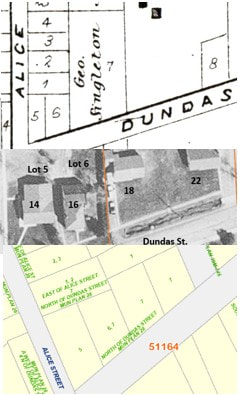
Village Lot 7 supports the modern addresses of #18 and #22 Dundas Street, up to the west side of Daniels Dr. Lot 7 is an extra-large lot that was labelled “Geo. Singleton” in the 1878 Belden County Atlas map. As we can see in the aerial photo of the 1960s, at Dundas Street there are two properties in the south end of lot 7, #18 and #22 Dundas St.
Today, #18 is a home and #22 has been repurposed to be a medical clinic. Daniels Drive runs north from Dundas St., along the east side of #22.
OnLand shows that the lots have changed to be similar in width and there are two distinct properties in lot 7. However, note that lot 6 shares part of the west part of lot 7, meaning we have a potential for 3 ownership streams in this set of data. Two for sure.
Lot 7 shares the same path as lot 6, all the way up to the sale by Ivan and Annie Whalen to Lillian Goodrich in 1962. The 1965 voters list shows that Anthony Wright, a produce manager, and his wife Colleen, are renting 18 Dundas Street. The 1968 list shows Mrs. Robert Hughes as a tenant.
Today, #18 is a home and #22 has been repurposed to be a medical clinic. Daniels Drive runs north from Dundas St., along the east side of #22.
OnLand shows that the lots have changed to be similar in width and there are two distinct properties in lot 7. However, note that lot 6 shares part of the west part of lot 7, meaning we have a potential for 3 ownership streams in this set of data. Two for sure.
Lot 7 shares the same path as lot 6, all the way up to the sale by Ivan and Annie Whalen to Lillian Goodrich in 1962. The 1965 voters list shows that Anthony Wright, a produce manager, and his wife Colleen, are renting 18 Dundas Street. The 1968 list shows Mrs. Robert Hughes as a tenant.
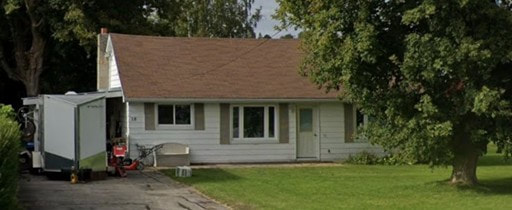
In 1971, 18 Dundas St. was sold by the estate of Frank Goodrich to Leo and Helen Marcoux, but they turn it around quickly by selling to Gordon and Annie Gerow. This couple are living here according to the 1972 voters list, showing his work as “D.N.D.”. In 1985, Annie Gerow sells the property to Robert and Carol Hood.
22 Dundas Street
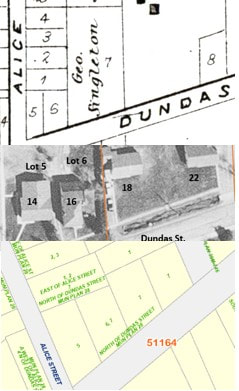
The property at 22 Dundas Street occupies Village Lot 7, on the north-east corner of Dundas and Daniels Drive. Recently it was repurposed to serve as a medical clinic.
The history of #18 and # 22 are mostly the same since they are both part of the original Village lot 7. In the 1960s, #22 was a rental property, with Lloyd Wilson of the R.C.A.F. there with his wife in 1965 and 1968.
In 1971, the estate of Frank Goodrich sold #22 to the Veterans Land Act and in 1972, we see Bruce Hooper, a manager, and his wife Mary at 22 Dundas Street. The Veterans Land Act sold to Maurice and May Jones in 1984 and they turned it over quickly to Errol and Greta Baker.
In 1988, it went to Joye Waterhouse for development.
The building at the corner became a doctor’s office for a time around 2020.
The history of #18 and # 22 are mostly the same since they are both part of the original Village lot 7. In the 1960s, #22 was a rental property, with Lloyd Wilson of the R.C.A.F. there with his wife in 1965 and 1968.
In 1971, the estate of Frank Goodrich sold #22 to the Veterans Land Act and in 1972, we see Bruce Hooper, a manager, and his wife Mary at 22 Dundas Street. The Veterans Land Act sold to Maurice and May Jones in 1984 and they turned it over quickly to Errol and Greta Baker.
In 1988, it went to Joye Waterhouse for development.
The building at the corner became a doctor’s office for a time around 2020.
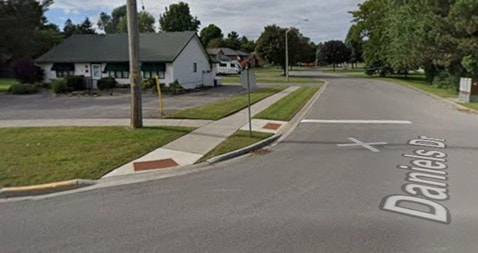
28 Dundas Street

The property at 28 Dundas Street is on the north-east corner of Dundas Street and Daniels Drive. Daniels Drive is a recent development but it was a path or lane for many years because it represented the middle of lot 35.
On the 1866 Brighton Plan we can see that the east half of lot 35 goes east from lot 7, labelled as “Mrs. Sanford”, around and not including lot 8, and through the land labelled “Hiram Bulkley” to Pinnacle Street. No. 28 Dundas was therefore in the west half of the east half of lot 35.
This also means that transactions related to 28 Dundas Street must be gleaned from the large collection of land records for lot 35, concession A, Brighton Twp. Collecting records for specific properties is much more complex when the land in these areas is not designated as village lots.
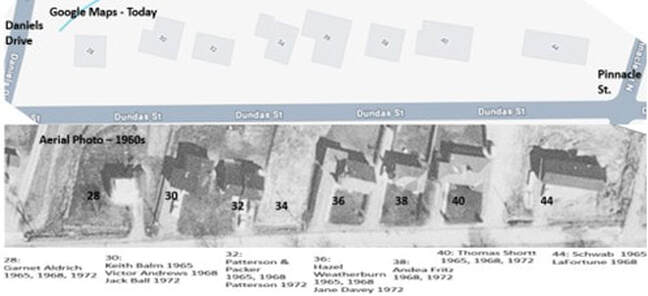
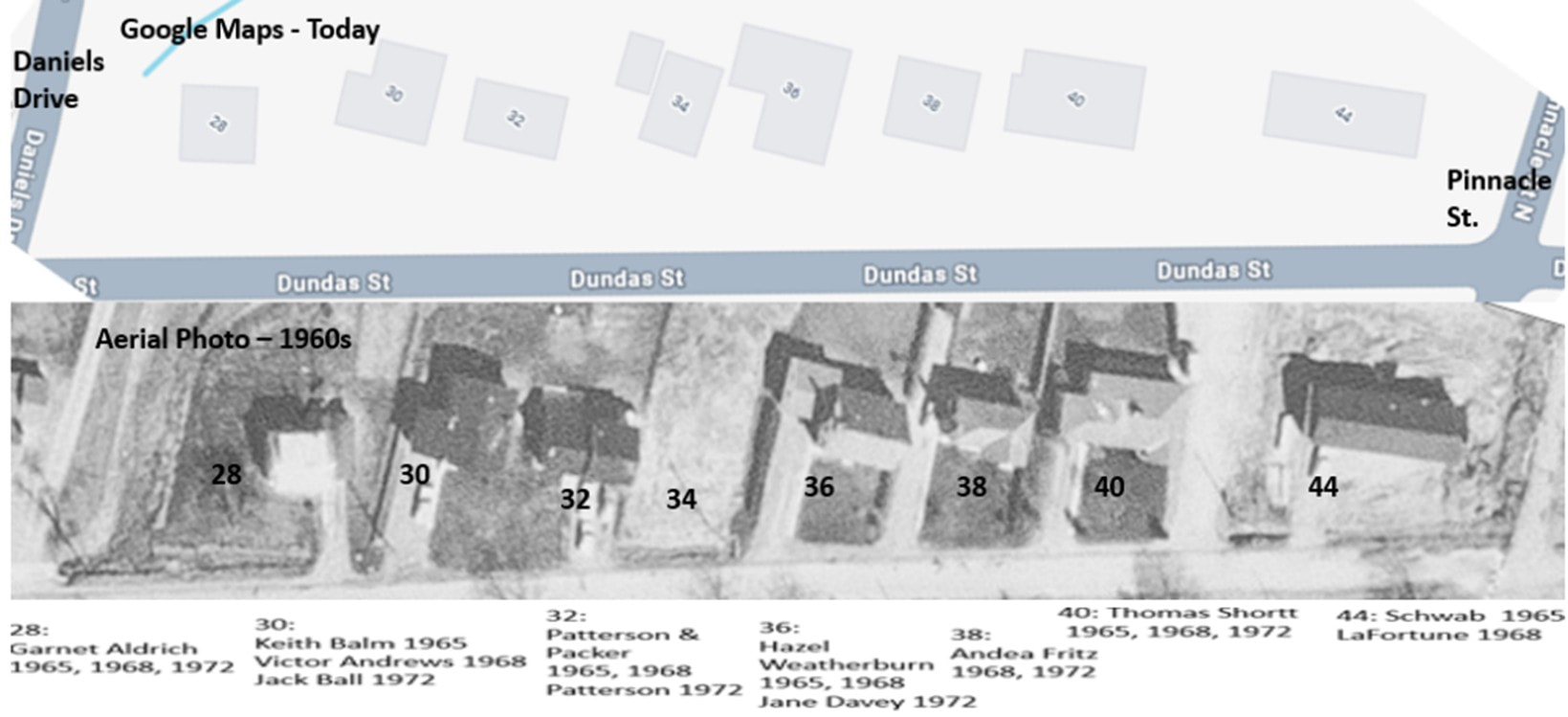
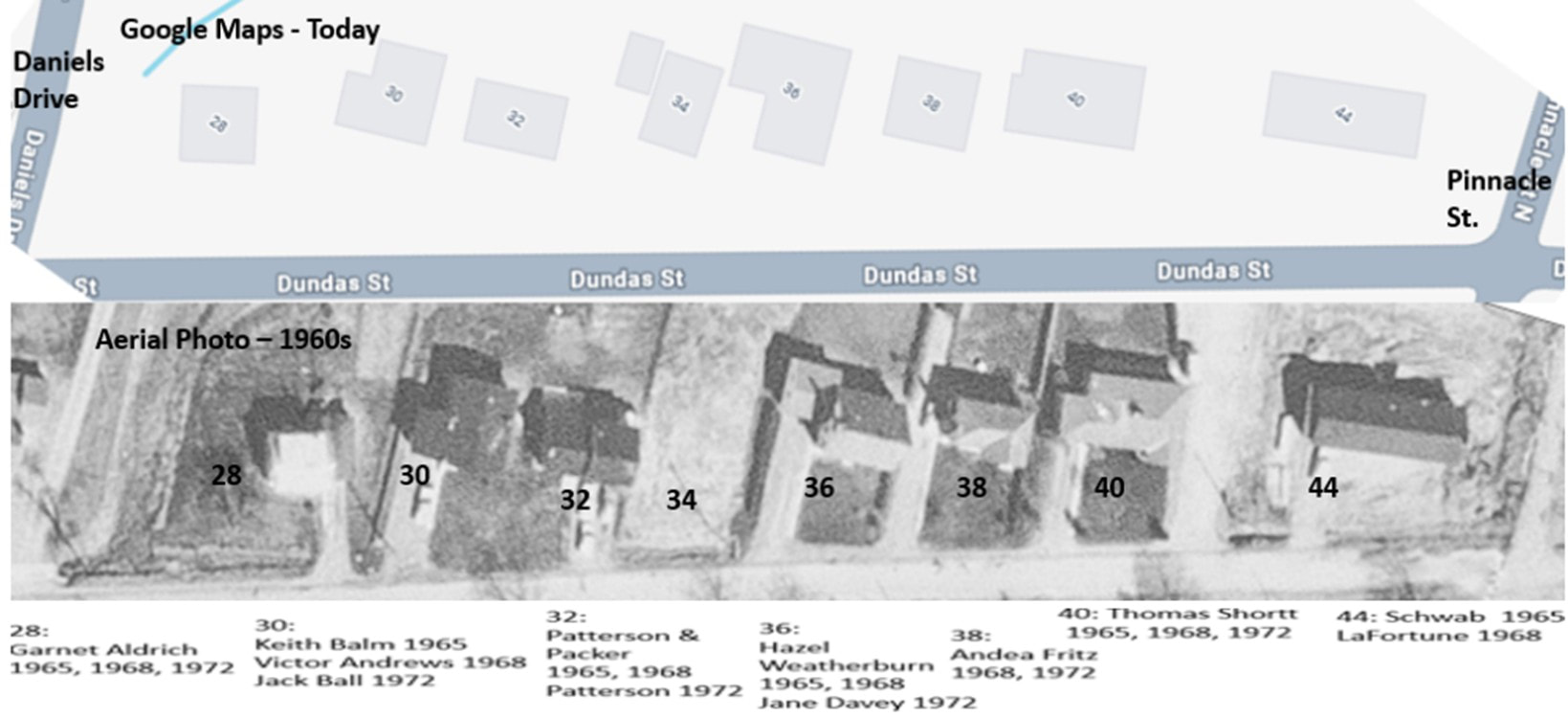
The top part of this image shows the location of the houses along the north side of Dundas Street between Daniels Drive and Pinnacle Street and the bottom part shows the same properties in an aerial photo in the 1960s. Note that there was on house at #34 in the 1960s, since added.
On the 1866 Brighton Plan we can see that the east half of lot 35 goes east from lot 7, labelled as “Mrs. Sanford”, around and not including lot 8, and through the land labelled “Hiram Bulkley” to Pinnacle Street. No. 28 Dundas was therefore in the west half of the east half of lot 35.
This also means that transactions related to 28 Dundas Street must be gleaned from the large collection of land records for lot 35, concession A, Brighton Twp. Collecting records for specific properties is much more complex when the land in these areas is not designated as village lots.
The top part of this image shows the location of the houses along the north side of Dundas Street between Daniels Drive and Pinnacle Street and the bottom part shows the same properties in an aerial photo in the 1960s. Note that there was on house at #34 in the 1960s, since added.
Historically, this land had a very different path from the land to the west. Of course, it was all part of Ann Marsh’s Patent in 1825, but then, in 1833, she and Archibald Chisholm sold “the west half of the east half” of lot 35 to Robert Weller (1803-1879), a son of Asa Weller and Hannah Marsh of the Carrying Place. In 1832 he married Mary Dorman Sanford (1811-1851) who was a daughter of Thomas Dorman Sanford and Anna Hawley. The Sanfords were some of the earliest settlers at this place that would become the town of Brighton and they acquired large land holdings which could be sold off in bits over time in order meet the demand for land in town and to earn some revenue. As a result, Robert Weller, became involved in numerous land transactions with the backing of his wife’s resources.
In 1838, Robert Weller sold “part east half, 46 acres” of lot 35 to Isaac C. Proctor. Isaac Chamberlain Proctor (1790-1866) was a son of Josiah Proctor and Susanna Chamberlain, one of the first settler families in the immediate area that would become Brighton. The Proctor and Sanford families did much real estate business with each other and with others in these early decades.
In 1849, Isaac C. Proctor sold the same 46 acres to Adeline E. Sanford. Adeline Eliza Proctor (1818-1904) was a daughter of Isaac C. Proctor and Elizabeth Smith and she married William Hawley Sanford (1815-1870) in 1836. W. H. Sanford managed the Sanford Hotel in Brighton for many years, although his wife and younger children ended up in Rochester.
In 1838, Robert Weller sold “part east half, 46 acres” of lot 35 to Isaac C. Proctor. Isaac Chamberlain Proctor (1790-1866) was a son of Josiah Proctor and Susanna Chamberlain, one of the first settler families in the immediate area that would become Brighton. The Proctor and Sanford families did much real estate business with each other and with others in these early decades.
In 1849, Isaac C. Proctor sold the same 46 acres to Adeline E. Sanford. Adeline Eliza Proctor (1818-1904) was a daughter of Isaac C. Proctor and Elizabeth Smith and she married William Hawley Sanford (1815-1870) in 1836. W. H. Sanford managed the Sanford Hotel in Brighton for many years, although his wife and younger children ended up in Rochester.
Thirty-seven years later, in 1886, Adeline E. Sanford sold “all east half of west half north of Dundas St.” with the exception of lot 8 to Nathan A. Simpson. Nathan Alonzo Simpson (1858-1955) was son of John K, Simpson and Pheobe Ann Huff, this group being part of the very large Simpson clan that settled here under Obediah Simpson, considered a first settler of Brighton. Most often called Alonzo, he married Hattie Russell in 1884 and was an active businessman in Brighton.
Fifty-one years later, Morley R. Simpson sold part of this land north of Dundas Street to William and Sarah Daniels. Morley Arthur Russell Simpson (1900-1991) was a son of Nathan Alonzo Simpson and Hattie Russell and he married Muriel Margaret Wells in 1924. He was extremely busy in the real estate market and also was heavily involved in the apple business.
William Henry Daniels (1900-1985) was from Coe Hill in Hastings County, but came to Brighton as a young man and was married to Sarah Susannah Bird in 1921. Starting in 1933, William and Sarah Daniels accumulated a significant amount of real estate in this area north of Dundas Street and east of Young Street. They would parlay their investments into a major development business.
Fifty-one years later, Morley R. Simpson sold part of this land north of Dundas Street to William and Sarah Daniels. Morley Arthur Russell Simpson (1900-1991) was a son of Nathan Alonzo Simpson and Hattie Russell and he married Muriel Margaret Wells in 1924. He was extremely busy in the real estate market and also was heavily involved in the apple business.
William Henry Daniels (1900-1985) was from Coe Hill in Hastings County, but came to Brighton as a young man and was married to Sarah Susannah Bird in 1921. Starting in 1933, William and Sarah Daniels accumulated a significant amount of real estate in this area north of Dundas Street and east of Young Street. They would parlay their investments into a major development business.
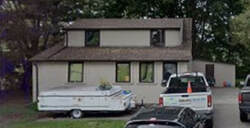
The voters lists for 1965 and 1968 show that Garnet Aldrich, a C.N.R. employee, lived at 28 Dundas St. with his wife. In 1970, William and Sarah Daniels sold 28 Dundas Street to Garnet and Greta Aldrich, so we see them at this address for the 1972 voters list.
In 1979 Garnet and Greta Aldrich sold the property to Naomi Stucky. Records for #30 Dundas Street show that Naomi Stucky acquired that property in 1980, so had both 28 and 30.
In 1979 Garnet and Greta Aldrich sold the property to Naomi Stucky. Records for #30 Dundas Street show that Naomi Stucky acquired that property in 1980, so had both 28 and 30.
30 Dundas Street
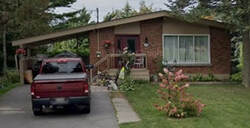
The property at 30 Dundas Street is the next property east of #28 which is on the north-east corner of Dundas St. and Daniels Drive.
No. 30 is in the same part of lot 35 as No. 28, so the same land transactions apply until recent times.
The land records diverge from #28 with the sale of the property in 1958 by Wiliam and Sarah Daniels to Marie Pilcher. There is no information for this lady and she sold the property on to Cornelius Balm in 1963, also no information. Keith Balm, a teacher, was living at 30 Dundas Street with his wife according to the 1965 voters list. In 1968, another teacher, Victor Andres, with his wife, also a teacher, were living there.
In 1970 Cornelius Balm sold 30 Dundas Street to Jack and Beatrice Ball, and they are shown living there in the 1972 voters list, he being retired. In 1980, Jack Ball sold the property to Naomi Stucky, who also had #28.
No. 30 is in the same part of lot 35 as No. 28, so the same land transactions apply until recent times.
The land records diverge from #28 with the sale of the property in 1958 by Wiliam and Sarah Daniels to Marie Pilcher. There is no information for this lady and she sold the property on to Cornelius Balm in 1963, also no information. Keith Balm, a teacher, was living at 30 Dundas Street with his wife according to the 1965 voters list. In 1968, another teacher, Victor Andres, with his wife, also a teacher, were living there.
In 1970 Cornelius Balm sold 30 Dundas Street to Jack and Beatrice Ball, and they are shown living there in the 1972 voters list, he being retired. In 1980, Jack Ball sold the property to Naomi Stucky, who also had #28.
32 Dundas Street
|
|
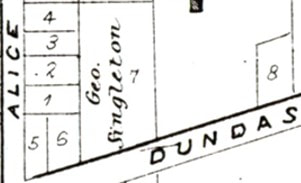
The property at 32 Dundas Street is in Village Lot 8. The 1878 map shows that lot 8 was well east from lot 7, with Mrs. Sanford the owner of the land to the north in lot 35. It contains properties #32, #34 and # 36.
The 1960s aerial photo shows several homes along the north side of Dundas between Daniels Drive to the left (west) and Pinnacle St. to the right (east).
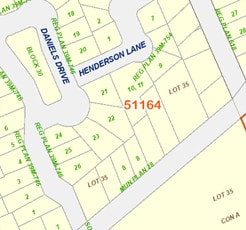
The OnLand.ca map for this area shows that there are two lots marked as 8. #32 would be toward the west side of these two lots.
The history of lot 8 diverges from lot 7 in 1888 when Isaac C. Sanford sold it to James H. Simpson. It is not clear which person this might be in the huge Simpson family, but we do know that in 1899, Alonzo N. Simpson sold it to James M. Simpson. If the middle initial is correct, this was a minister who ended up in Toronto.
Then, in 1930, James D. Simpson sold the lot to Morley R. Simpson. Morley Russell Simpson (1900-1991) was a son of Nathan Alonzo Simpson & Hattie Russell, married to Muriel Wells. He was very active in the apple business as well as real estate.
Morley Simpson sold lot 8 to William and Sarah Daniels in 1937. William Henry Daniels (1900-1985) was from Coe Hill, Hastings County, but came to Brighton as a young man. By 1933 he was buying up pieces of land in Brighton, largely north of Dundas St. & west of Young St. He married Sarah Susanna Bird in 1921 and this couple would make investments and parlay them into a successful real estate development business.
The 1960s aerial photo shows several homes along the north side of Dundas between Daniels Drive to the left (west) and Pinnacle St. to the right (east).
The OnLand.ca map for this area shows that there are two lots marked as 8. #32 would be toward the west side of these two lots.
The history of lot 8 diverges from lot 7 in 1888 when Isaac C. Sanford sold it to James H. Simpson. It is not clear which person this might be in the huge Simpson family, but we do know that in 1899, Alonzo N. Simpson sold it to James M. Simpson. If the middle initial is correct, this was a minister who ended up in Toronto.
Then, in 1930, James D. Simpson sold the lot to Morley R. Simpson. Morley Russell Simpson (1900-1991) was a son of Nathan Alonzo Simpson & Hattie Russell, married to Muriel Wells. He was very active in the apple business as well as real estate.
Morley Simpson sold lot 8 to William and Sarah Daniels in 1937. William Henry Daniels (1900-1985) was from Coe Hill, Hastings County, but came to Brighton as a young man. By 1933 he was buying up pieces of land in Brighton, largely north of Dundas St. & west of Young St. He married Sarah Susanna Bird in 1921 and this couple would make investments and parlay them into a successful real estate development business.
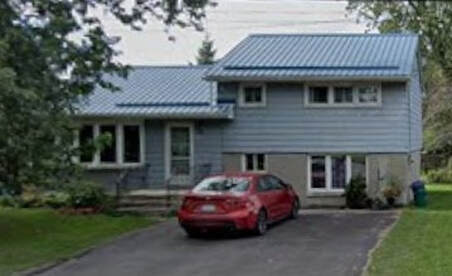
In 1958, Daniels sold lot 8 to Marie J. Pilcher and in 1964, she and her husband, Percy E. Pilcher sold to The Higgins Company Ltd., probably to build a house at 32 Dundas Street. In 1965, the estate of Percy Pilcher sold the property to Albert and Marjorie Patterson.
The 1965 voter lists show Joseph Packer and wife living at 32 Dundas Street, with Mrs. Marjorie Patterson, their daughter. Albert Patterson and his wife Marjorie are there in 1968, along with Joseph Packer. Albert and Marjory of there in the 1972 voters list. In 1986, the estate of Albert Patterson passed the property to son Jon E. Patterson.
In 1992 there is a new plan that references the John E. Patterson transaction, but we see the CIBC selling the property to Rebecca Louise Brant, who is also referenced there in 2002.
The 1965 voter lists show Joseph Packer and wife living at 32 Dundas Street, with Mrs. Marjorie Patterson, their daughter. Albert Patterson and his wife Marjorie are there in 1968, along with Joseph Packer. Albert and Marjory of there in the 1972 voters list. In 1986, the estate of Albert Patterson passed the property to son Jon E. Patterson.
In 1992 there is a new plan that references the John E. Patterson transaction, but we see the CIBC selling the property to Rebecca Louise Brant, who is also referenced there in 2002.
34 Dundas Street
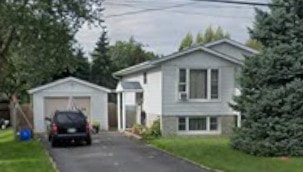
The house at 34 Dundas Street is relatively new and there is no Plan in OnLand.ca in reference to this property.
History of the land is the same as the others in Lot 8.
History of the land is the same as the others in Lot 8.
36 Dundas Street
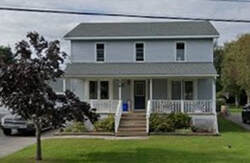
The property at 36 Dundas Street is in the east side of Village Lot 8. The history of this property is the same as #32 until after William and Sarah Daniels acquire lot 8 in 1937. After that, there are two houses on the lot, #32 on the west side and #36 on the east side. Later, #34 would be built in the space between these two.
In 1957, William & Sarah Daniels sold 36 Dundas Street to Pearl Hazel Weatherburn (1921-1998), the unmarried daughter of Thomas Weatherburn and Jane Mitchell, farmers on Concession 3 of Brighton Twp. In all three voters lists Hazel is described as a secretary. In 1965 and 1972 she is with her sister, Jane Davey. She was buried in Mount Hope Cemetery, mentioned on the memorial of James Carman Davey, a nephew.
In 1985, Pearl H. Weatherburn sold 36 Dundas Street to Leo and Ann McAuley.
In 1957, William & Sarah Daniels sold 36 Dundas Street to Pearl Hazel Weatherburn (1921-1998), the unmarried daughter of Thomas Weatherburn and Jane Mitchell, farmers on Concession 3 of Brighton Twp. In all three voters lists Hazel is described as a secretary. In 1965 and 1972 she is with her sister, Jane Davey. She was buried in Mount Hope Cemetery, mentioned on the memorial of James Carman Davey, a nephew.
In 1985, Pearl H. Weatherburn sold 36 Dundas Street to Leo and Ann McAuley.
38 Dundas Street
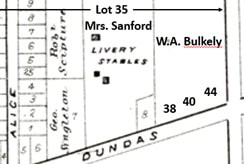
The property at 38 Dundas Street is in the east half of the east half of lot 35, so the far eastern side of that original township lot. The map shows that #38, #40 and #44 are in that same section, up to Pinnacle Street. It is important to note that this eastern part is labelled “W.A. Bulkley”, which means its history is different from the land the west.
In 1836, Ann Marsh and her sons Angus and Archibald Chisholm sold 45 acres on the east part of lot 35 to Hiram Bulkley (1805-1868), a recent arrival from Connecticut, who had been married to Jane Valleau in Fredericksburgh Twp. in 1831. The next year, in 1832, his son Stiles was born in Cramahe Twp. where Hiram established himself as a “joiner” which means carpenter. He became very much engaged in real estate speculation in the growing community and his descendants would carry on.
In 1862, the estate of Hiram Bulkley granted the same 45 acres to his youngest son William Andrew Bulkley (1847-1925) who would marry Emily Phillips in 1880 and became a very active merchant in Brighton, also using the family resources to invest in real estate.
The names W. A. Bulkley is on this land in the Belden County Atlas which was produced in 1878. The next year, he sold the same land to Abel Snelgrove (1854-c1925), a son of Robert Snelgrove and Mary McMaster. He married Eliza Vincent (1856-1902), a daughter of Stephen Vincent and Mary Scott. After his wife died in 1902, Abel homesteaded in Saskatchewan with some of his children.
Abel Snelgrove sold this land in 1894 to William Dorland Clapp (1839-1914), a son of Dorland Clapp and Julia Ann Dorland. This family lived mostly in Hillier Township, but was in Brighton for a time, making several real estate investments. The same land was sold back to W. A. Bulkley a year later and three years later, in 1898, it was sold to William & Clarence Vincent. William Vincent (1867-1929) was a son of Stephen Vincent and Mary Scott, so a brother of Eliza Vincent, wife of Abel Snelgrove. In 1911 he married Elva Maybee. Clarence Theodore Vincent (1874-1938) was a brother of William Vincent, married to Della Permelia Rowley. He was a farmer near Smithfield.
In 1862, the estate of Hiram Bulkley granted the same 45 acres to his youngest son William Andrew Bulkley (1847-1925) who would marry Emily Phillips in 1880 and became a very active merchant in Brighton, also using the family resources to invest in real estate.
The names W. A. Bulkley is on this land in the Belden County Atlas which was produced in 1878. The next year, he sold the same land to Abel Snelgrove (1854-c1925), a son of Robert Snelgrove and Mary McMaster. He married Eliza Vincent (1856-1902), a daughter of Stephen Vincent and Mary Scott. After his wife died in 1902, Abel homesteaded in Saskatchewan with some of his children.
Abel Snelgrove sold this land in 1894 to William Dorland Clapp (1839-1914), a son of Dorland Clapp and Julia Ann Dorland. This family lived mostly in Hillier Township, but was in Brighton for a time, making several real estate investments. The same land was sold back to W. A. Bulkley a year later and three years later, in 1898, it was sold to William & Clarence Vincent. William Vincent (1867-1929) was a son of Stephen Vincent and Mary Scott, so a brother of Eliza Vincent, wife of Abel Snelgrove. In 1911 he married Elva Maybee. Clarence Theodore Vincent (1874-1938) was a brother of William Vincent, married to Della Permelia Rowley. He was a farmer near Smithfield.
In 1902, Clarence quit claimed his interest in the land to his brother William and the estate of William Vincent granted the land to John Robert Vincent (1864-1944), another brother of William and Clarence. He married Rosa Roblin in 1893 and was described as a fruit dealer and carpenter.
In 1929, Elva Vincent, William’s widow, quit claimed her interest in the land to John Vincent and, in a few months, he sold it to Albert Edward “Bert” Hennessey (1898-1969), a son of Isaac Wellington Hennessey and Jennie Woof who farmed in Brighton and Murray Townships. He married Greta Edith Baird in 1824 and soon was established in Brighton as a mechanic. He developed a very successful auto repair and body shop business on the west side of Young Street, south of Sanford St.
In 1949, Bert Hennessey sold 44 acres in the east quarter of lot 35, north of Dundas Steet to Arthur Hayden Butters (1908-1992), a son of James Butters and Edith Brisbin who were farmers in Haldimand Township. Arthur married Muriel Alberta Macklin (1911-1999) a daughter of William Arthur Macklin and Caroline Adams. Arthur and his brother-in-law, Bruce Macklin, ran a bottling works on Young Street, beside the Hennessey garage.
Two years later Arthur & Muriel Butters sold part of the land north of Dundas Street to Thomas and Muriel Shortt. Thomas Aquila Shortt (1922-2015) was an Englishman who came to Canada as a child in 1929, when his father, Thomas Aquilla Shortt and mother, Hilda Sowerby, established themselves in a rented home in Brighton. Thomas Sr. was a labourer but as the younger Thomas grew up, he became involved as a contractor in Brighton. He married Muriel Cheer (1926-2015) a daughter of Ralph Cheer and Viola Reynolds. Later they were divorced and he married Elizabeth (Hyatt) Weaver (1937 - ) a daughter of Ross Weaver and Gladys Hicks.
In 1929, Elva Vincent, William’s widow, quit claimed her interest in the land to John Vincent and, in a few months, he sold it to Albert Edward “Bert” Hennessey (1898-1969), a son of Isaac Wellington Hennessey and Jennie Woof who farmed in Brighton and Murray Townships. He married Greta Edith Baird in 1824 and soon was established in Brighton as a mechanic. He developed a very successful auto repair and body shop business on the west side of Young Street, south of Sanford St.
In 1949, Bert Hennessey sold 44 acres in the east quarter of lot 35, north of Dundas Steet to Arthur Hayden Butters (1908-1992), a son of James Butters and Edith Brisbin who were farmers in Haldimand Township. Arthur married Muriel Alberta Macklin (1911-1999) a daughter of William Arthur Macklin and Caroline Adams. Arthur and his brother-in-law, Bruce Macklin, ran a bottling works on Young Street, beside the Hennessey garage.
Two years later Arthur & Muriel Butters sold part of the land north of Dundas Street to Thomas and Muriel Shortt. Thomas Aquila Shortt (1922-2015) was an Englishman who came to Canada as a child in 1929, when his father, Thomas Aquilla Shortt and mother, Hilda Sowerby, established themselves in a rented home in Brighton. Thomas Sr. was a labourer but as the younger Thomas grew up, he became involved as a contractor in Brighton. He married Muriel Cheer (1926-2015) a daughter of Ralph Cheer and Viola Reynolds. Later they were divorced and he married Elizabeth (Hyatt) Weaver (1937 - ) a daughter of Ross Weaver and Gladys Hicks.
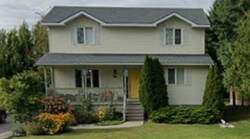
Thomas Shortt built homes here and in 1955 sold 38 Dundas Street to Andrea L. Fritz. Andree Lucienne Deles (1897-1986) was born in France and married Canadian soldier Morley Frederick Fritz in England in 1919. They came back to Brighton and he worked as an inspector until his death in 1955. Soon after, Andrea bought 38 Dundas St. She is shown to be a nurse in the voters lists of 1965 and 1972, living at 38 Dundas Street.
The estate of Andrea L. Fritz passed the property to her son, Albert Morley Fritz (1933-1996) who married Ruth Eleanor Bates in 1959, she from a farm family in Haldimand Township. In 1996, his estate granted 38 Dundas Street to his wife Ruth who died in Kingston in 2011.
The estate of Andrea L. Fritz passed the property to her son, Albert Morley Fritz (1933-1996) who married Ruth Eleanor Bates in 1959, she from a farm family in Haldimand Township. In 1996, his estate granted 38 Dundas Street to his wife Ruth who died in Kingston in 2011.
40 Dundas Street
The property at 40 Dundas Street, like #38, is in the east quarter of lot 35, labelled “W.A. Bulkley” on the Brighton Plan of 1866. The 1960s aerial photo shows several homes along the north side of Dundas west of Pinnacle St. to the right (east), with the Brighton Public School across Dundas St. The OnLand.ca map for this area shows the more recent developments, with the lot at the corner for 44 Dundas St.
The history for #40 is the same as #38 until the early 1950s. Thomas Shortt is shown to be a building contractor in Brighton from 1951 to 1990. In 1952, James and Isabel Solomon sold the property at 40 Dundas Street to Thomas and Muriel Shortt and they are shown to be living there in 1963, 1965 and 1972 voters lists, described as a contractor in each case.
In 1992, 40 Dundas Street was sold to Harry Earl and Hilda Thompson.
The history for #40 is the same as #38 until the early 1950s. Thomas Shortt is shown to be a building contractor in Brighton from 1951 to 1990. In 1952, James and Isabel Solomon sold the property at 40 Dundas Street to Thomas and Muriel Shortt and they are shown to be living there in 1963, 1965 and 1972 voters lists, described as a contractor in each case.
In 1992, 40 Dundas Street was sold to Harry Earl and Hilda Thompson.
44 Dundas Street
The property at 44 Dundas Street is in Lot 35 Conc A, on the north-west corner of Dundas and Pinnacle Streets. It IS in the east quarter of lot 35, labelled “W.A. Bulkley” on the Brighton Plan of 1866. The 1960s aerial photo shows several homes along the north side of Dundas west of Pinnacle St. to the right (east), with the Brighton Public School across Dundas St. The OnLand.ca map for this area shows the more recent developments, with the lot at the corner for 44 Dundas St.
The history of 44 Dundas Street is the same as #40 until 1947 when Albert Hennessey sold 1 acre to the Veterans Land Act, which was a common mechanism to “park” some land for a few years until it was bought back. In the meantime, this was a rental property, with the family of Charles Schwab living there from 1945 to 1965. Mr. Schwab died in 1967 and the land was sold by the Veterans Land Act to the estate of Charles Schwab, with Vida, his wife as executor.
Within a year, 44 Dundas Street was sold by the Charles Schwab estate to Elvin and Mary Ried, who sold in 1970 to Morgin Investments Ltd., who sold to Howard King in 1971. There was a foreclosure and Howard King sold to Robert and Lorna LaFortune I 1972. They sold to Hauan & Hu Hua in 1982 and they sold to Bruce & Patricia Blagdon in 1999. There are references to this owner in 2005.
The history of 44 Dundas Street is the same as #40 until 1947 when Albert Hennessey sold 1 acre to the Veterans Land Act, which was a common mechanism to “park” some land for a few years until it was bought back. In the meantime, this was a rental property, with the family of Charles Schwab living there from 1945 to 1965. Mr. Schwab died in 1967 and the land was sold by the Veterans Land Act to the estate of Charles Schwab, with Vida, his wife as executor.
Within a year, 44 Dundas Street was sold by the Charles Schwab estate to Elvin and Mary Ried, who sold in 1970 to Morgin Investments Ltd., who sold to Howard King in 1971. There was a foreclosure and Howard King sold to Robert and Lorna LaFortune I 1972. They sold to Hauan & Hu Hua in 1982 and they sold to Bruce & Patricia Blagdon in 1999. There are references to this owner in 2005.
50 Dundas Street
Now we move east on Dundas Street, across Pinnacle Street and into township lot 34. E.N.S.S. is across the street. The property at 50 Dundas Street is the second property east of Pinnacle Street but the north-east corner of Alice and Dundas Streets is occupied by 30 Alice Street, which is not included in this study.
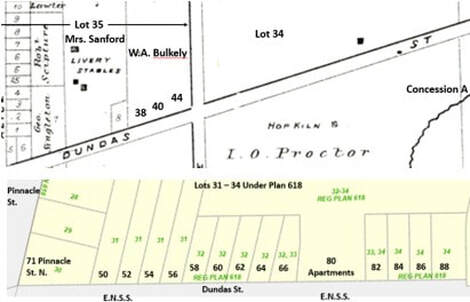
There are 14 properties east of Pinnacle Street as shown on this map from OnLand which spreads across Blocks 31, 32, 33 and 34. These are part of the larger Plan 618 which was implement in 1989.
The modern properties of #50 through #88 Dundas Street were originally part of the Tackaberry farm and would not be developed until 18 acres of land was sold to a group of investors in 1973 and development of individual properties began.
There are 14 properties east of Pinnacle Street as shown on this map from OnLand which spreads across Blocks 31, 32, 33 and 34. These are part of the larger Plan 618 which was implement in 1989.
The modern properties of #50 through #88 Dundas Street were originally part of the Tackaberry farm and would not be developed until 18 acres of land was sold to a group of investors in 1973 and development of individual properties began.
The history of lot 34, Concession A, Murray Township began with the Patent from the Crown for all 200 acres being granted to Kings College on January 3, 1828. This means that it was reserved by the government to be sold later for revenue to support education. It was held in this status through the creation of the village of Brighton in 1831 and the creation of the township of Brighton on January 1, 1852 which made this land part of the new township.
The first transaction for this lot after the Patent is the Will of Isaac C. Proctor which granted part of the west quarter of lot 34 to William C. Proctor. Isaac Chamberlain Proctor (1790-1866) was a son of Josiah Proctor who had come to the area in 1810 and created a major homestead on Main Street near today’s funeral home. One of his sons was William Chamberlain Proctor (1832-1913) who was a brother of the much better-known John Edward Proctor.
At the same time, the Will granted another part of the west half of lot 34 to Isaac Oscar Proctor (1836-1918), another brother of William C. and John E. Proctor. The descriptions in these transactions are minimal so it is hard to speculate which exact land is being addressed in each case. In 1862, Isaac C. Proctor granted more land in lot 34 to William C. Proctor, again, unclear as to specifics. Then, in 1875, William sells part of the south half of lot 34 to Isaac O. Proctor. This land was in the Proctor family for a long time and it appears as if the brothers were competing over the various pieces of the land. Maybe there was another explanation at the time.
In any case, it was not until 1913 that Isaac O. Proctor sold all 200 acres of lot 34 to Samuel H. Tackaberry. Samuel Harrison Tackaberry (1965-1941) was born in Watertown, NY and came to this area as a youngster. The family was here for the 1871 Census. He married Sophia Anne Macklam in 1890, her second marriage. They farmed in Brighton Township and possibly on the land they purchased in 1913. The older house at 94 Dundas Street appears to be the Tackaberry farm house.
The first transaction for this lot after the Patent is the Will of Isaac C. Proctor which granted part of the west quarter of lot 34 to William C. Proctor. Isaac Chamberlain Proctor (1790-1866) was a son of Josiah Proctor who had come to the area in 1810 and created a major homestead on Main Street near today’s funeral home. One of his sons was William Chamberlain Proctor (1832-1913) who was a brother of the much better-known John Edward Proctor.
At the same time, the Will granted another part of the west half of lot 34 to Isaac Oscar Proctor (1836-1918), another brother of William C. and John E. Proctor. The descriptions in these transactions are minimal so it is hard to speculate which exact land is being addressed in each case. In 1862, Isaac C. Proctor granted more land in lot 34 to William C. Proctor, again, unclear as to specifics. Then, in 1875, William sells part of the south half of lot 34 to Isaac O. Proctor. This land was in the Proctor family for a long time and it appears as if the brothers were competing over the various pieces of the land. Maybe there was another explanation at the time.
In any case, it was not until 1913 that Isaac O. Proctor sold all 200 acres of lot 34 to Samuel H. Tackaberry. Samuel Harrison Tackaberry (1965-1941) was born in Watertown, NY and came to this area as a youngster. The family was here for the 1871 Census. He married Sophia Anne Macklam in 1890, her second marriage. They farmed in Brighton Township and possibly on the land they purchased in 1913. The older house at 94 Dundas Street appears to be the Tackaberry farm house.
Samuel H. Tackaberry died in 1941 and in 1954, one of his sons, Harrison Tackaberry granted part of lot 34 to his brother, Willard Tackaberry. Harrison Mullett Tackaberry (1903-1974) was a son of Samuel H. Tackaberry and his second wife, Maude Mullett; he remained single. Willard Van Wicklin Tackaberry (1906-2000) was a brother of Harrison and he was married to Muriel Mildred Young in 1933. Gladys Maude Tackaberry (1902-1994) was a sister and she married William J. West around 1949 in California, where they lived.
Development began to happen in this area in 1959 when Willard Tackaberry sold part of lot 34 south of Dundas Street to the Ontario Ministry of Public Works, which was for the new high school. Then, in 1969, Willard Tackaberry sold 18 acres of land north of Dundas Street to a consortium of local investors. The names mentioned are Robert S. Nesbitt, Norman A. Dickens, Gordon J. Spencer and Benjamin C. Thompson.
In 1971 the 18 acres was transferred from this group of men to their wives and in 1973 the entire group, both men and women, sold the 18 acres to Maurice H. Rollins Construction Ltd. Two years later, Rollins sold part of the 18 acres to Tackaberry Farms Ltd. Then, in 1985, Tackaberry Farms Ltd. sold part of the land north of Dundas Street to Robert and Muriel Dunnett. Robert Warren Dunnett (1946 - ) was a son of Arthur Douglas Dunnett and Ethel Marion Maybee. In 1971 he married Muriel Jean Gourley. Robert was a farmer to the east, across the road at 143 Dundas St., the farm his father had established.
Development began to happen in this area in 1959 when Willard Tackaberry sold part of lot 34 south of Dundas Street to the Ontario Ministry of Public Works, which was for the new high school. Then, in 1969, Willard Tackaberry sold 18 acres of land north of Dundas Street to a consortium of local investors. The names mentioned are Robert S. Nesbitt, Norman A. Dickens, Gordon J. Spencer and Benjamin C. Thompson.
In 1971 the 18 acres was transferred from this group of men to their wives and in 1973 the entire group, both men and women, sold the 18 acres to Maurice H. Rollins Construction Ltd. Two years later, Rollins sold part of the 18 acres to Tackaberry Farms Ltd. Then, in 1985, Tackaberry Farms Ltd. sold part of the land north of Dundas Street to Robert and Muriel Dunnett. Robert Warren Dunnett (1946 - ) was a son of Arthur Douglas Dunnett and Ethel Marion Maybee. In 1971 he married Muriel Jean Gourley. Robert was a farmer to the east, across the road at 143 Dundas St., the farm his father had established.
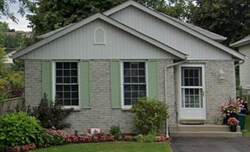
In 1988 Robert and Jean Dunnett sold part of this property to a numbered company and a new Plan organized the Blocks along the north side of Dundas Street. In July of 1994, part of the land went from the numbered company to M. Voskamp Holdings Limited. Here we are concerned about 50 Dundas Street which was established as Part 1 of Plan 39R-7909, registered in December of 1994.
In April of 1995, Voskamp sold 50 Dundas Street to Catalina Elizabeth Wilson, then, in 1998, she transferred it to herself and Janet Agnes Elizabeth Enns and Mark Vincent Hardman Wilson. The last transaction in 2004 shows the last two of this group to Elizabeth Ann Smith.
In April of 1995, Voskamp sold 50 Dundas Street to Catalina Elizabeth Wilson, then, in 1998, she transferred it to herself and Janet Agnes Elizabeth Enns and Mark Vincent Hardman Wilson. The last transaction in 2004 shows the last two of this group to Elizabeth Ann Smith.
52 Dundas Street
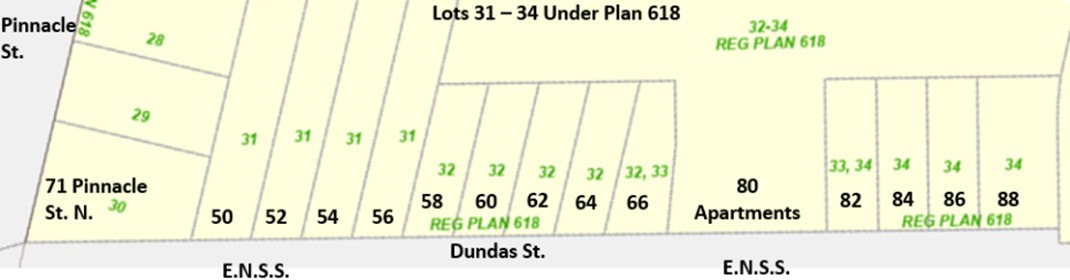
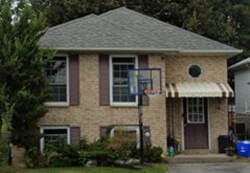
The history of 52 Dundas Street is the same as #50 until Voskamp sold #52 to Evelyn Forth in 1995, registered as Part 2 of Plan 39R-7090. She sold to Ewald Meyer and Anna Joan Ross in 1999 and they sold to Douglas & Sacha Whitton in 2008.
54 Dundas Street
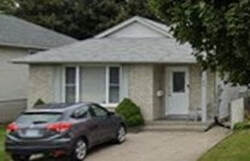
The history of 54 Dundas Street is the same as #50 until Voskamp sold #54 to Terry & Gail Michaud in 1996, registered as Part 3 of Plan 39R-7090. In 2004, Gail Michaud sold to Stanislava Elzbieta Conolly who was involved in the Brighton Independent newspaper. In 2005, 54 Dundas Street was sold to Carl Austin and Joan Brenda Turk.
56 Dundas Street
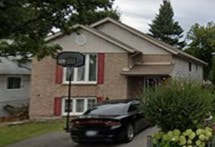
The history of 56 Dundas Street is the same as #50, 52 and 54 until Voskamp sold #56 to Patricia Marie Wager in 1994, registered as Part 4 of Plan 39R-7090. In 1998, she sold to Doni Gail Moore and in 2004 she sold to Julie Anne Marie Lawson. Records show that this owner was present in 2008.
58 Dundas Street
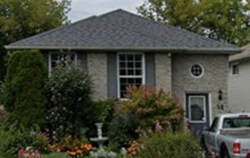
The history of 58 Dundas Street is the same as #50, 52, 54 and 56 until Voskamp sold #58 to Peter & Michell Thorp-Levitt in 1996, registered as Part 1 of Plan 39R-7557. In 2001 it was sold to Martha Madonna Warren and there is a transaction for this owner in 2007.
60 Dundas Street
The history of 60 Dundas Street is the same as #50, 52, 54, 56 and 58 until Voskamp sold #60 to Dorothy Lillian Neufeld in 1996, registered as Part 2 of Plan 39R-7557. In 2001 it was sold to Lisa Martha Simpkins and soon after to Elizabeth McGlashan Beno.
62 Dundas Street
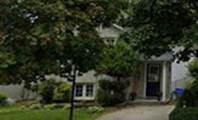
The history of 62 Dundas Street is the same as #50 through 60 until Voskamp sold #62 to Judy Anne Davis in 1997, registered as Part 1 of Plan 39R-7968. Soon after, it was sold to Susan Ruth Seymour.
64 Dundas Street
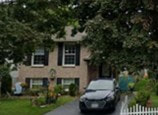
The history of 64 Dundas Street is the same as #50 through 62 until Voskamp sold #64 to Lisa Peters in 1998, registered as Part 2 of Plan 39R-7968. There is a transaction for the same owner in 2008.
66 Dundas Street
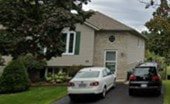
The history of 66 Dundas Street is the same as #50 through 64 until Voskamp sold #66 to Beverly Ann Tanner in 1999, registered as Part 3 of Plan 39R-7968. In 2000 it was sold to Bruce David Moore.
80 Dundas Street
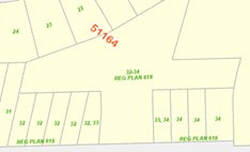
No. 80 Dundas Street is the apartment building in between #66 and #82 and is in a large, oddly shape area which is labeled on the OnLand map as “32-34, Reg. Plan 618”. This area was included in the same path as #50 to 66 until 2001 when it is sold by Voskamp to a numbered company with the content defined as parts of Blocks 32, 33 and 34 that were not included in the Plans 39R-7557 and 39R-7968.
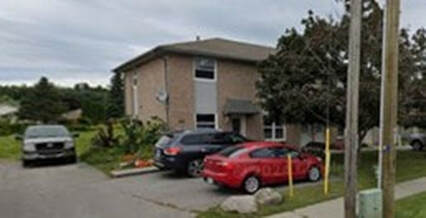
82 Dundas Street
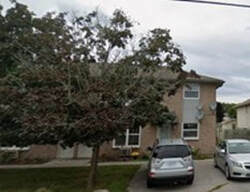
No. 82 Dundas Street is the first house east of the apartment building at #80. Properties #82, 84, 86 and 88 are in Block 34 of Plan 618. The history of #82 is the same as #50 through 80 until Voskamp sold #82 to Teresa Mary Bowen in 1999, registered as Part 4 of Plan 39R-7968. In 2004 it was sold to Uwe Wolfgang Borchert & Mary Borchert, the folks who had the furniture store on Main Street until recently. In 2008 82 Dundas St. was sold to Maureen Batten.
84 Dundas Street
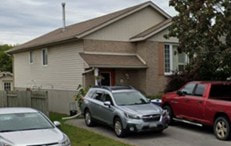
No. 84 Dundas Street is the second house east of the apartment building at #80. Properties #82, 84, 86 and 88 are in Block 34 of Plan 618. The history of #84 is the same as #50 through 82 until Voskamp sold #84 to Albert & Bernice Uens in 1999. The Estate of Bernice Uens sold it to Michael Terrancxe Szalawiga in 2003.
86 Dundas Street
No. 86 Dundas Street is the third house east of the apartment building at #80. Properties #82, 84, 86 and 88 are in Block 34 of Plan 618. The history of #86 is the same as #50 through 84 until Voskamp sold #86 to Ronald Warren & Emily Peppy in 1999, registered as Part 6 of Plan 39R-7978.
88 Dundas Street

No. 88 Dundas Street is the fourth house east of the apartment building at #80. Properties #82, 84, 86 and 88 are in Block 34 of Plan 618. The history of #88 is the same as #50 through 86 until Voskamp sold #88 to George & Doreen Ninacs in 1997, registered as Part 7 of Plan 39R-7978. There is a transaction for this owner in 2002.
92 Dundas Street
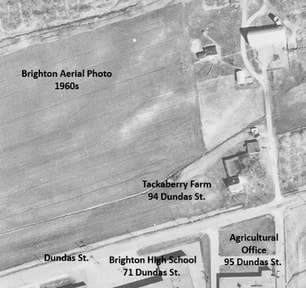
The property at 92 Dundas Street is immediately west of the old Tackaberry farm house. We can see in this snip of the 1960s aerial photo that the farm house stands alone on the north side of Dundas Street with barn and sheds down the lane to the north. Immediately across the street is the Agriculture Office, which also hosts the OPP station today. Clearly, the land along the north side of Dundas Street is open field, part of the Tackaberry farm.
The history of 92 Dundas Streety is the same as those to the west until 1988 when Robert and Muriel Dunnett sold the property to Al Vanderlaan Construction Inc. under Plan 39R-2785. Then, in 1989, Vanderlaan sold to Sam and Edna Hookey as Part 1 of Plan 38R-3482. They sold to Damon and Cory Alyea in 1993 as Part 1 of Pla 38R-3481. They sold to John & Linda Rowe in 1996.
We can se that 92 Dundas Street is immediately west of #94, the old Tackaberry farm house.
The history of 92 Dundas Streety is the same as those to the west until 1988 when Robert and Muriel Dunnett sold the property to Al Vanderlaan Construction Inc. under Plan 39R-2785. Then, in 1989, Vanderlaan sold to Sam and Edna Hookey as Part 1 of Plan 38R-3482. They sold to Damon and Cory Alyea in 1993 as Part 1 of Pla 38R-3481. They sold to John & Linda Rowe in 1996.
We can se that 92 Dundas Street is immediately west of #94, the old Tackaberry farm house.
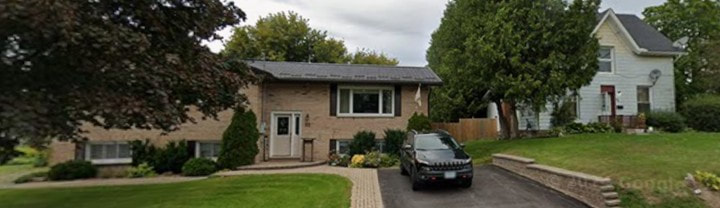
94 Dundas Street
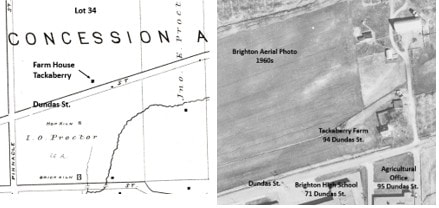
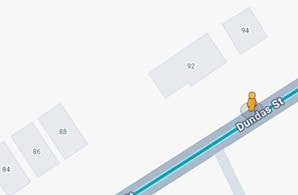
The property at 94 Dundas Street is the last house on the north side of Dundas Stret before the Dunnett orchards. The house is a small one-and-a-half storey house which has siding on it now but was probably brick. This was the main house for the Tackaberry family and farm.
The 1878 Belden County Atlas shows that there is a building at this location at that time, when the Proctor family owned the land. It is unclear who lived there before Samuel Tackaberry acquired the farm in 1913.
The 1878 Belden County Atlas shows that there is a building at this location at that time, when the Proctor family owned the land. It is unclear who lived there before Samuel Tackaberry acquired the farm in 1913.
The 1960s aerial photo shows that this house was alone on Dundas Street north at this time, with farm buildings down a lane to the north. The house is immediately across Dundas Street from the Agricultural office where the OPP Station is located today. This Google Maps image shows that #92 and #94 are separated from #88 by an open space where #90 might be. The driveway of #92 is on this space.
The history of lot 34, Concession A, Murray Township began with the Patent from the Crown for all 200 acres being granted to Kings College on January 3, 1828. This means that it was reserved by the government to be sold later for revenue to support education. It was held in this status through the creation of the village of Brighton in 1831 and the creation of the township of Brighton on January 1, 1852 which made this land part of the new township.
The first transaction for this lot after the Patent is the Will of Isaac C. Proctor which granted part of the west quarter of lot 34 to William C. Proctor. Isaac Chamberlain Proctor (1790-1866) was a son of Josiah Proctor who had come to the area in 1810 and created a major homestead on Main Street near today’s funeral home. One of his sons was William Chamberlain Proctor (1832-1913) who was a brother of the much better-known John Edward Proctor.
At the same time, the Will granted another part of the west half of lot 34 to Isaac Oscar Proctor (1836-1918), another brother of William C. and John E. Proctor. The descriptions in these transactions are minimal so it is hard to speculate which exact land is being addressed in each case. In 1862, Isaac C. Proctor granted more land in lot 34 to William C. Proctor, again, unclear as to specifics. Then, in 1875, William sells part of the south half of lot 34 to Isaac O. Proctor. This land was in the Proctor family for a long time and it appears as if the brothers were competing over the various pieces of the land. Maybe there was another explanation at the time.
The history of lot 34, Concession A, Murray Township began with the Patent from the Crown for all 200 acres being granted to Kings College on January 3, 1828. This means that it was reserved by the government to be sold later for revenue to support education. It was held in this status through the creation of the village of Brighton in 1831 and the creation of the township of Brighton on January 1, 1852 which made this land part of the new township.
The first transaction for this lot after the Patent is the Will of Isaac C. Proctor which granted part of the west quarter of lot 34 to William C. Proctor. Isaac Chamberlain Proctor (1790-1866) was a son of Josiah Proctor who had come to the area in 1810 and created a major homestead on Main Street near today’s funeral home. One of his sons was William Chamberlain Proctor (1832-1913) who was a brother of the much better-known John Edward Proctor.
At the same time, the Will granted another part of the west half of lot 34 to Isaac Oscar Proctor (1836-1918), another brother of William C. and John E. Proctor. The descriptions in these transactions are minimal so it is hard to speculate which exact land is being addressed in each case. In 1862, Isaac C. Proctor granted more land in lot 34 to William C. Proctor, again, unclear as to specifics. Then, in 1875, William sells part of the south half of lot 34 to Isaac O. Proctor. This land was in the Proctor family for a long time and it appears as if the brothers were competing over the various pieces of the land. Maybe there was another explanation at the time.
In 1913, Isaac O. Proctor sold all 200 acres of lot 34 to Samuel Harrison Tackaberry (1965-1941) who was born in Watertown, NY and came to this area as a youngster. The family was here for the 1871 Census. There is a large Tackaberry family in the Hilton/Orland/Codrington area but genealogy work has not established a link between those folks and Samuel Tackaberry.
In any case, we know that Samuel H. Tackaberry grew up in Brighton Township, probably with his Vanwicklin relatives. His mother died in 1885 and he was married in 1890 to Sophia Ann Macklam (1865-1899) who was the daughter of Thomas Macklam and Elizabeth Mullett. Sophia had been married in 1884 to Alva Newton Metcalf who died in 1889 leaving one son, Bruce, from that marriage.
Sophia Tackaberry gave birth to one son, Bause, who died as an infant, then she died three years later in 1899. In the meantime, Samuel Tackaberry was working in the town of Brighton as a harness maker. In 1890, his wife, Sophia, purchased Village Lot 12 on the north side of Main Street, Brighton, where address 148 Main Street would later be identified. About a year later, Samuel and Sophia sold the same property to Lucinda McDonald. Both transactions were for $800. A few months later, Lucinda McDonald and husband sold the same property back to Samuel and Sophia for the same amount. We can only speculate what these exchanges were about. In any case, we can expect that Samuel Tackaberry may have lived at 148 Main Street, and may have built the brick house we see there today.
Then, in 1901, Samuel married Maude Mullett (1870-1918), who was born at Cannifton in Hastings County, the daughter of Daniel Haight Mullett and Cordelia Holt. They farmed in Brighton Township and lived in the older house which became 94 Dundas Street when the post office applied street numbers.
In any case, we know that Samuel H. Tackaberry grew up in Brighton Township, probably with his Vanwicklin relatives. His mother died in 1885 and he was married in 1890 to Sophia Ann Macklam (1865-1899) who was the daughter of Thomas Macklam and Elizabeth Mullett. Sophia had been married in 1884 to Alva Newton Metcalf who died in 1889 leaving one son, Bruce, from that marriage.
Sophia Tackaberry gave birth to one son, Bause, who died as an infant, then she died three years later in 1899. In the meantime, Samuel Tackaberry was working in the town of Brighton as a harness maker. In 1890, his wife, Sophia, purchased Village Lot 12 on the north side of Main Street, Brighton, where address 148 Main Street would later be identified. About a year later, Samuel and Sophia sold the same property to Lucinda McDonald. Both transactions were for $800. A few months later, Lucinda McDonald and husband sold the same property back to Samuel and Sophia for the same amount. We can only speculate what these exchanges were about. In any case, we can expect that Samuel Tackaberry may have lived at 148 Main Street, and may have built the brick house we see there today.
Then, in 1901, Samuel married Maude Mullett (1870-1918), who was born at Cannifton in Hastings County, the daughter of Daniel Haight Mullett and Cordelia Holt. They farmed in Brighton Township and lived in the older house which became 94 Dundas Street when the post office applied street numbers.
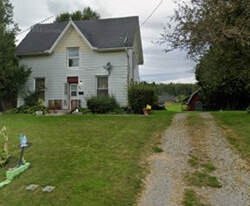
Samuel H. Tackaberry died in 1941 and in 1954, one of his sons, Harrison Tackaberry, granted part of lot 34 to his brother, Willard Tackaberry. Harrison Mullett Tackaberry (1903-1974) was a son of Samuel H. Tackaberry and his second wife, Maude Mullett; he remained single. Willard Van Wicklin Tackaberry (1906-2000) was a brother of Harrison and he was married to Muriel Mildred Young in 1933. Gladys Maude Tackaberry (1902-1994) was a sister and she married William J. West around 1949 in California, where they lived.
Development began to happen in this area in 1959 when Willard Tackaberry sold part of lot 34 south of Dundas Street to the Ontario Ministry of Public Works, which was for the new high school. The Canada Voters Lists show that Willard Tackaberry and his wife lived with Harrison Tackaberry at 94 Dundas Street in 1965 and again in 1968.
Then, in 1969, Willard Tackaberry sold 18 acres of land north of Dundas Street to a consortium of local investors, and he provided a mortgage. The Grantee names mentioned are Robert S. Nesbitt, Norman A. Dickens, Gordon J. Spencer and Benjamin C. Thomspon. In 1971 the 18 acres was transferred from this group of men to their wives and in 1973 the entire group, both men and women, sold the 18 acres to Maurice H. Rollins Construction Ltd.
Two years later, Rollins sold part of the 18 acres to Tackaberry Farms Ltd. Then, in 1985, Tackaberry Farms Ltd. sold part of the land north of Dundas Street to Robert and Muriel Dunnett. Robert Warren Dunnett (1946 - ) was a son of Arthur Douglas Dunnett and Ethel Marion Maybee. In 1971 he married Muriel Jean Gourley. Robert was a farmer across the road at 143 Dundas St., the farm his father had established.
Six months later, Robert Dunnett sold 94 Dundas Street to James and Diane Ingram as Part 1 of Plan 38R-2956. They sold it in 1997 to William Boulton and he sold I 1999 to Robert Warren Dunnett, so the old Tackaberry farm house came back to the Dunnett family.
Development began to happen in this area in 1959 when Willard Tackaberry sold part of lot 34 south of Dundas Street to the Ontario Ministry of Public Works, which was for the new high school. The Canada Voters Lists show that Willard Tackaberry and his wife lived with Harrison Tackaberry at 94 Dundas Street in 1965 and again in 1968.
Then, in 1969, Willard Tackaberry sold 18 acres of land north of Dundas Street to a consortium of local investors, and he provided a mortgage. The Grantee names mentioned are Robert S. Nesbitt, Norman A. Dickens, Gordon J. Spencer and Benjamin C. Thomspon. In 1971 the 18 acres was transferred from this group of men to their wives and in 1973 the entire group, both men and women, sold the 18 acres to Maurice H. Rollins Construction Ltd.
Two years later, Rollins sold part of the 18 acres to Tackaberry Farms Ltd. Then, in 1985, Tackaberry Farms Ltd. sold part of the land north of Dundas Street to Robert and Muriel Dunnett. Robert Warren Dunnett (1946 - ) was a son of Arthur Douglas Dunnett and Ethel Marion Maybee. In 1971 he married Muriel Jean Gourley. Robert was a farmer across the road at 143 Dundas St., the farm his father had established.
Six months later, Robert Dunnett sold 94 Dundas Street to James and Diane Ingram as Part 1 of Plan 38R-2956. They sold it in 1997 to William Boulton and he sold I 1999 to Robert Warren Dunnett, so the old Tackaberry farm house came back to the Dunnett family.